Two people search the same firm collection for the same memo and get different results. The search engine is rarely the reason. The reason is that the memo was described inconsistently when it went in: one person filed it under the client’s industry, a second under the practice area, a third under the partner who wrote it. Nothing is broken, and nothing can be found.
A legal taxonomy is the controlled vocabulary a legal organization uses to classify its own documents, matters and records: the agreed terms for practice areas, matter types, jurisdictions and document types. Legal metadata management is the wider practice of defining, applying and governing the values recorded against those terms, so the records can be found, controlled and relied on.
This guide is a working reference rather than an introduction. It covers what a legal taxonomy is, how the related terms fit together, how legal metadata differs from metadata in other fields, which published standard suits which job, and the decisions a firm has to settle internally before any standard will hold. The alphabetized reference further down describes the individual standards, schemes and models in detail.
What is a legal taxonomy, and why does the term mean two different things?
Search for legal taxonomy and you will find two unrelated bodies of work sitting side by side. Knowing which one you have opened saves a good deal of time.
The first is a question in legal theory. Emily Sherwin’s paper Legal Taxonomy, published in Legal Theory in 2009, examines how legal materials themselves should be organized, comparing formal classification by rules of order, functional classification by social purpose, and classification by underlying reasons. The subject is the shape of the law.
The second is an operational question inside an organization. It asks how a particular firm should label its own material so that people can retrieve it, and its reference point is a standard such as the SALI Alliance Legal Matter Specification Standard, which gives the industry shared terminology for classifying matters, time, documents and organizations.
| Doctrinal legal taxonomy | Information-management legal taxonomy | |
| What it classifies | Legal doctrine and causes of action | Documents, matters and records |
| Typical question | Should unjust enrichment sit apart from contract? | Which practice area does this memo belong to? |
| Who works on it | Legal scholars, judges, law students | Law firm librarians, knowledge lawyers, legal operations |
| Reference point | Academic legal theory | SALI LMSS, Library of Congress Class K, a firm’s own matter codes |
| Where it lives | Journals and textbooks | The library system, the document management system, the intranet |
This guide covers the second. The two do touch at one point worth noting: a scheme built on a coherent view of legal subject matter tends to age better than one assembled from whatever the intranet navigation happened to need three years ago. Beyond that they are separate problems with separate owners.
What is the purpose of a legal taxonomy in a firm?
It does three jobs at once, and a scheme designed around only one of them tends to come under pressure from the other two.
Retrieval: A shared vocabulary is what allows a litigation associate and a knowledge lawyer to search the same collection and arrive at the same document. Where the vocabulary is not shared, retrieval quality is capped by description quality, whatever technology sits on top of it.
Aggregation: Consistent matter and practice-area terms are what make it possible to answer “what have we done in this area before”, which is the question underneath pitches, panel submissions and lateral onboarding.
Control: In legal collections, the fields that make a record findable frequently intersect with the fields and permissions that decide who may reach it. Classification and access control are not wholly separate problems here in the way they often are in a public library catalog, and that shapes much of what follows.
What is legal metadata management?
Legal metadata management covers which fields exist on a record, which values are permitted in them, who applies those values, and who is accountable when they are wrong. It is closer to a governance discipline than a technical one. The challenge is rarely capturing metadata at all. It is agreeing what each field means, which values are permitted, and who governs them.
The three conventional types are worth keeping as a distinction, because each one tends to go wrong in a different way and needs a different control.
| Type | What it records | Examples in a legal collection | Who sets it | Where it goes wrong |
| Descriptive | What the item is and what it is about | Title, author, matter ID, practice area, jurisdiction, subject terms | Applied by staff, ideally against a controlled vocabulary | Inconsistency, where two people read the same field differently |
| Administrative | How the item may be handled | Access restrictions, retention period, license and rights terms, record owner, review status | Set by policy, applied at cataloging or ingest | Neglect, where nobody revisits a value after the policy changes |
| Technical | What the file itself is | File format, encoding, size, creation and modification timestamps, originating software | Generated by the system, within whatever the system is configured to capture | Disclosure, because a file may carry values the person sharing it did not enter or review |
A second distinction runs across all three. Some values are generated by a system without anyone deciding anything in the moment. Others are applied deliberately, by a person or by a rule. Human-applied descriptive metadata carries the subject and matter information that makes a collection retrievable, because somebody made a judgment about what the item is. System-generated metadata describes technical characteristics and the events associated with a file, which is a different kind of useful. Automatic generation does not by itself make a value accurate, complete or admissible, and technical metadata can still be stripped, normalized by a conversion, or misread. Treating the two kinds as interchangeable causes trouble, particularly when a system timestamp is read as a statement about when work was done.
What a working taxonomy actually changes
Classification competes for time against billable priorities, so it is worth being concrete about what it returns rather than calling it good practice.
- Research that is not repeated: Precedents, research memos and model documents are reused only when someone who did not write them can find them. Classification is what makes precedent capture and retrieval work across a firm rather than inside one team’s shared drive.
- Subscriptions you can justify: Resource records described consistently can be reported on by practice group, which turns a renewal conversation into a decision rather than a negotiation. The wider framework for this sits in our guide to legal resource management.
- Onboarding that does not depend on one person: A lateral hire or an incoming information services manager inherits a collection they can navigate, rather than a filing logic that left with a colleague.
- Governance you can audit: Retention, access and license terms recorded as fields can be reported on. The same terms held in people’s heads cannot.
These returns scale with the size of the collection. In a small firm it is often quicker to ask the person who wrote the document. That approach stops working as offices and practice groups multiply, and the moment it stops working is usually noticed some time after it has passed.
Taxonomy, thesaurus, controlled vocabulary: which term means what
These words are used loosely in practice, and the looseness causes real confusion when a firm is comparing systems or reading a standard. The boundaries between them are not always clean, and the W3C makes the same point in its own SKOS documentation when it describes thesauri, classification schemes and taxonomies as a family of related systems rather than sharply separated categories. What follows is a set of working definitions for legal information management, not a universal hierarchy.
| Term | What it is | In a legal collection |
| Metadata | The values recorded about a record | Matter ID, jurisdiction, date, practice area |
| Controlled vocabulary | The fixed set of values a field is allowed to take | The approved list of practice areas, so nobody invents a new one at the keyboard |
| Taxonomy | A controlled vocabulary arranged into broader and narrower relationships | Litigation, then Employment beneath it, then Discrimination beneath that |
| Thesaurus | A vocabulary with further relationships expressed, including synonyms, variants and related terms | “Non-compete” and “restrictive covenant” resolving to the same concept |
| Classification scheme | A system that assigns items to classes, usually with notation | The Dewey 340s, or Library of Congress Class K |
| Ontology | A formal model of entities and the relationships between them, capable of supporting inference | Modelling that a matter has a client, a jurisdiction and a responsible partner, and what follows from that |
| SKOS | A W3C data model and RDF vocabulary for representing and exchanging the systems above. Not itself a legal subject vocabulary | Expressing a firm’s practice-area taxonomy so another system can consume it |
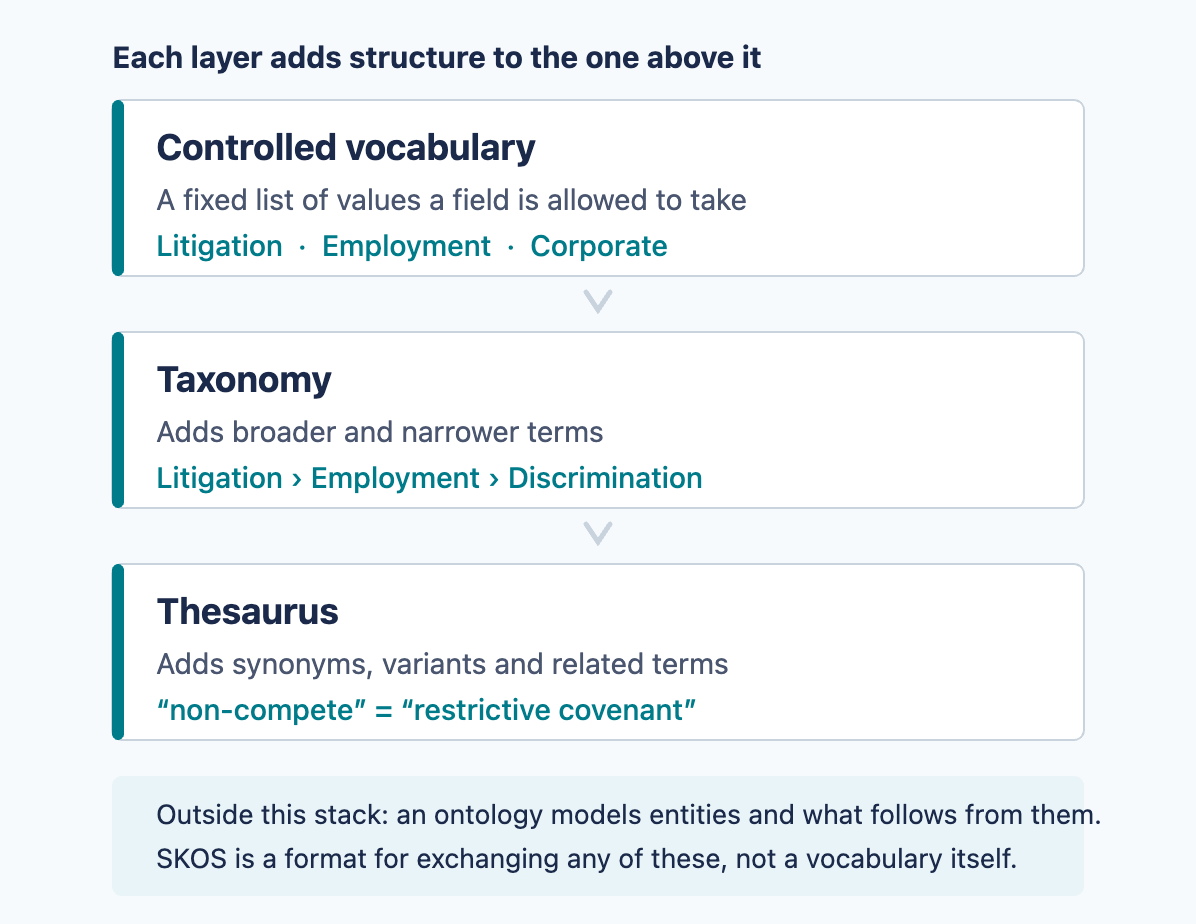
SKOS is particularly easy to misunderstand. The SKOS Reference, published by the W3C in 2009, describes it as a common data model for sharing and linking knowledge organization systems, designed to carry existing thesauri, taxonomies and classification schemes rather than to replace them. When a vendor says a system “supports SKOS”, that is a statement about exchange, not about the quality of the vocabulary inside it.
Where lawyers and practice groups use different words for the same concept, thesaurus relationships are more useful than a plain hierarchy, because synonyms and preferred terms can be managed explicitly rather than left to whoever happens to be searching.
How does legal metadata differ from metadata in other fields?
Legal metadata is often explained by analogy to library cataloging or to clinical coding. Both analogies hold up to a point. The point at which they break is where most of the practical difficulty sits.
| Field | Standards commonly referenced | Mainly optimized for | Where it diverges from legal practice |
| Legal | SALI LMSS, Library of Congress Class K, commercial research taxonomies, court filing schemas | Retrieval by matter, jurisdiction and practice area, alongside access and retention control | Description carries privilege, retention and disclosure consequences, not findability alone |
| Healthcare | HL7 FHIR, ICD-11 | Exchange between systems, and coded clinical and billing accuracy | Coding is largely prescribed externally; legal classification is mostly decided inside the organization |
| Financial services | FINRA and SEC books-and-records requirements | Supervisory reporting and a demonstrable audit trail | Scope is set by regulators; legal description is set by practice need alongside obligation |
| Libraries and archives | MARC 21, Dublin Core, EAD, ISAD(G) | Consistent description and collection-level discovery | The closest discipline, and the one where access rules rest on different grounds |
Two differences account for most of the gap.
The firm defines its own scheme: A clinician coding a diagnosis and a firm filing a regulatory report are both applying a classification somebody else wrote, where compliance largely means applying it correctly. Legal taxonomies are mostly built by the organizations using them. Shared standards exist, and SALI provides an industry-developed vocabulary for describing legal work, but a firm still decides how its own material maps onto that vocabulary. The governance burden stays inside the firm in a way it does not in regulated coding environments.
Description and access control occupy the same record: In many fields, description helps people find things and access control is handled somewhere else. In legal collections the fields that make a precedent retrievable frequently sit alongside the fields that decide who may retrieve it. That is why classification cannot be handed wholesale to whoever administers search, and why a scheme designed only for discovery tends to need rework once access questions arrive.
Archives restrict access too, on grounds including donor agreements, privacy, law, institutional policy and the condition of the material. Legal information environments add a further dimension, because access may also depend on the client, the matter, the role of the person asking and the confidentiality attached to the work. Librarians and archivists moving into legal settings usually find the descriptive mechanics familiar and that second dimension unfamiliar. The description standards transfer. What takes adjustment is that a restriction can follow a matter rather than a collection, and can change as the matter does.
Which standard does which job?
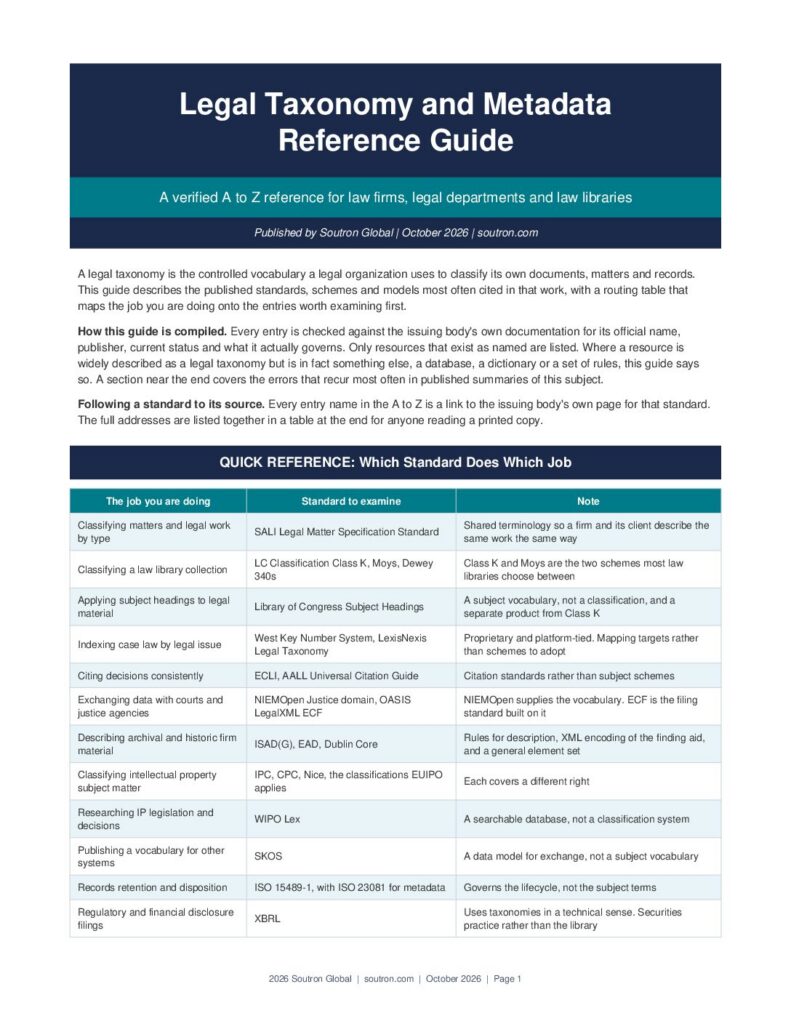
The alphabetized reference below describes each entry in detail. The table here is the shortcut: it maps the job you are trying to do onto the entries worth examining first. Different parts of a legal collection call for different schemes, which is why the table maps each job to a relevant entry rather than naming one scheme to adopt across the whole collection.
| The job you are doing | Standard, taxonomy or framework to examine | Note |
| Classifying matters and legal work by type | SALI Legal Matter Specification Standard | Shared terminology designed so a firm and its client can describe the same work the same way |
| Classifying a law library collection | Library of Congress Classification Class K, Moys Classification and Thesaurus for Legal Materials, Dewey Decimal 340s | Class K and Moys are the two schemes most law libraries choose between. Moys, designed by Elizabeth Moys and first published in 1968, is used across common law jurisdictions including the UK, Ireland, Canada, Australia and New Zealand |
| Applying subject headings to legal material | Library of Congress Subject Headings | A subject vocabulary rather than a classification, and a separate product from Class K. Law headings are interspersed alphabetically rather than gathered in a law section |
| Indexing case law by legal issue | West Key Number System, LexisNexis Legal Taxonomy | Proprietary and tied to the platform, so treat these as mapping targets rather than schemes to adopt |
| Identifying and citing decisions consistently | ECLI, AALL Universal Citation Guide | Citation standards rather than subject schemes. ECLI for European case law, AALL for vendor-neutral US citation |
| Exchanging structured data with courts and justice agencies | NIEMOpen and its Justice domain, OASIS LegalXML Electronic Court Filing | NIEMOpen supplies the shared vocabulary. ECF is the court filing standard built on it |
| Describing archival and historic firm material | ISAD(G), EAD, Dublin Core | Three different functions: ISAD(G) sets the rules for archival description, EAD encodes the resulting finding aid in XML, and Dublin Core supplies a general-purpose metadata element set |
| Classifying intellectual property subject matter | IPC, Cooperative Patent Classification, Nice Classification, the classifications EUIPO applies | Each covers a different right. Nice classifies goods and services for trademark filing; IPC and CPC classify patent subject matter |
| Researching IP legislation, treaties and decisions | WIPO Lex | A searchable database of IP laws, treaties and judicial decisions rather than a classification system |
| Publishing a vocabulary so other systems can read it | SKOS | A data model for exchange, not a subject vocabulary in its own right |
| Records retention and disposition | ISO 15489-1, with ISO 23081 for records metadata | Records-management standards rather than cataloging schemes. They govern the lifecycle, not the subject terms |
| Regulatory and financial disclosure filings | XBRL | A reporting standard that uses taxonomies in a technical sense. Relevant to securities and regulatory practices rather than to the library collection |
Two cautions are worth stating plainly. Adopting a published standard does not remove the need for local decisions, because every entry above still has to be mapped onto your own material. And a scheme that fits one part of a collection rarely fits all of it, so the realistic goal is a small number of schemes that interoperate rather than one that wins.
Legal Taxonomy and Metadata Reference Guide
28 standards, schemes and models. One print-ready PDF.
- Every entry checked against the issuing body’s own documentation
- A routing table showing which standard fits which job
- SALI, LC Class K, Moys, West Key Number, ECLI, NIEMOpen and more
- A section on the standards most often miscited
- Every standard linked to its issuing body, with the full addresses listed for printed copies
- Built for law firms, legal operations and law libraries
No sign-up required. Instant access.
Alphabetized Legal Metadata Taxonomies List
Each entry below has been checked against the issuing body’s own documentation for its official name, publisher, current status and what it actually governs. Where a resource is commonly described as a legal taxonomy but is in fact something else, that is stated rather than glossed over.
AALL Universal Citation Guide
A set of vendor-neutral citation rules for judicial decisions, statutes and administrative regulations, recommended by the American Association of Law Libraries and published in its third edition (2014) by William S. Hein & Co. It is a citation standard rather than a subject classification, so it governs how a decision is cited, not how it is indexed.
Cooperative Patent Classification (CPC)
Developed and maintained jointly by the United States Patent and Trademark Office and the European Patent Office, CPC is the controlling classification for patent subject matter and is used by patent offices worldwide. The older United States Patent Classification is static for utility patents, which stopped receiving USPC codes after 31 December 2014, and is now updated only for design and plant classes.
Cornell Legal Information Institute and Wex
The Legal Information Institute at Cornell Law School publishes Wex, a free legal dictionary and encyclopedia with a browsable subject index of roughly 200 legal topics. It is a navigational subject listing rather than a published controlled vocabulary, and it is not distributed as a structured taxonomy, so treat it as a reference source rather than a scheme to adopt.
Dewey Decimal Classification, Law (340 to 349)
The Dewey Decimal Classification, owned and maintained by OCLC, assigns law to the 340s: 340 Law, 341 Law of nations, 342 Constitutional and administrative law, 343 Military, tax, trade and industrial law, 344 Labour, social, education and cultural law, 345 Criminal law, 346 Private law, 347 Civil procedure and courts, 348 Laws, regulations and cases, and 349 Law of specific jurisdictions. It is a general library classification with a law range rather than a legal scheme, which is why most dedicated law libraries use Moys or Library of Congress Class K instead.
Dublin Core
Maintained by the Dublin Core Metadata Initiative, Dublin Core provides a general-purpose set of 15 core metadata elements, now part of DCMI Metadata Terms, widely used for describing documents in repositories including legal collections. DCMI publishes no legal profile, although individual projects have mapped Dublin Core to legal material, including Cornell LII’s documented mapping for judicial opinion metadata.
EAD (Encoded Archival Description)
An XML standard for encoding archival finding aids, maintained by the Society of American Archivists’ Technical Subcommittee on Encoded Archival Standards, with the Library of Congress hosting the official schemas. The current version is EAD 4, and legal repositories use it to describe court records, government legal archives and law firm collections, including the legal status of records.
ECLI (European Case Law Identifier)
A standardised identifier and an accompanying minimum set of uniform metadata for case law, based on Dublin Core, introduced by Council of the European Union conclusions in 2011 and revised in 2019. Adoption is voluntary by member state, each appoints a national ECLI coordinator, and the European Commission runs the ECLI search engine on the e-Justice Portal.
EUIPO and the classifications it applies
The European Union Intellectual Property Office does not publish a classification of its own. It applies three WIPO-administered systems, Nice for goods and services, Vienna for figurative trade mark elements, and Locarno for industrial designs, and co-maintains with EU national offices the Harmonised Database of pre-approved goods and services terms, accessible through TMclass, DesignClass and EuroLocarno.
ICCS (International Classification of Crime for Statistical Purposes)
Published by the United Nations Office on Drugs and Crime and endorsed in 2015 by the UN Statistical Commission and the Commission on Crime Prevention and Criminal Justice, ICCS version 1.0 classifies criminal offences by event type so that crime and criminal justice data can be compared across countries. It is a statistical classification rather than a legal information scheme, and it does not cover drug scheduling.
ICD (International Classification of Diseases)
The International Statistical Classification of Diseases and Related Health Problems is maintained by the World Health Organization, with ICD-11 in force since January 2022. It is not a legal standard, but its codes function as a controlled vocabulary for injury types and causes of death recorded on death certificates and referenced in personal injury, workers’ compensation and coronial matters.
IFLA LRM (Library Reference Model)
Published by IFLA in 2017, LRM is a high-level conceptual model for bibliographic information that consolidates FRBR, FRAD and FRSAD into a single model. It is a conceptual framework rather than a metadata schema or vocabulary, and it reaches legal collections indirectly, through RDA, the cataloguing standard built on it.
IPC (International Patent Classification)
Administered by WIPO under the Strasbourg Agreement of 1971, the IPC is a hierarchical, language-independent system of sections, classes, subclasses and groups used worldwide to classify patents and utility models. A new version takes effect each 1 January.
ISO 5127, Information and documentation, Foundation and vocabulary
A terminology standard that defines a concept system and general vocabulary for documentation, libraries, archives, media, museums, records management and conservation. Clause 3.13 covers legal aspects of information and documentation, chiefly intellectual property, author’s rights, privacy and data protection, rather than legal records terminology.
ISO 15489-1 and ISO 23081
ISO 15489-1:2016 sets out the concepts and principles for creating, capturing and managing records, including policy, responsibilities, records controls and records processes. It is not a metadata standard. The metadata requirements sit in ISO 23081, currently parts 1:2017 (Principles), 2:2021 (Conceptual and implementation issues) and 3:2011 (Self-assessment method).
LexisNexis Legal Taxonomy
The proprietary subject classification underlying the LexisNexis research platform, surfaced through Lexis headnotes and the legal topic hierarchy used in Search by Topic and Search by Headnote. It is not published as a browsable public vocabulary, so treat it as a mapping target rather than a scheme to adopt.
Library of Congress Classification, Class K (Law)
The hierarchical shelf classification for legal materials, running across subclasses K to KZ and covering law in general, comparative law, jurisprudence, religious law and the laws of individual jurisdictions. It is the scheme most academic and large law libraries use, and it is a different product from Library of Congress Subject Headings.
Library of Congress Subject Headings (LCSH)
A single alphabetical controlled vocabulary maintained by the Library of Congress Policy and Standards Division and in use since 1898. It has no distinct law section: law headings are interspersed alphabetically with all others. LCSH describes what an item is about, while Class K decides where it sits on the shelf, and the two are routinely confused.
MARC Code List for Relators
Maintained by the Library of Congress Network Development and MARC Standards Office, this is a controlled list of three-character codes and terms describing the role a person or corporate body plays in relation to a resource. It includes legal roles such as defendant, plaintiff, appellant, appellee, judge and witness, listed alphabetically among all other relators rather than grouped as a named legal subset.
Moys Classification and Thesaurus for Legal Materials
A hierarchical classification scheme and thesaurus for legal collections, created by Elizabeth M. Moys in 1968 and designed to sit alongside Library of Congress Classification. The current fifth edition, revised by Diana Morris, was published by De Gruyter Saur in 2012 under the auspices of the British and Irish Association of Law Librarians, and the scheme is used in law libraries across common law jurisdictions including the UK, Ireland, Canada, Australia and New Zealand.
Nice Classification (NCL)
The international classification of goods and services for trademark registration, established by the Nice Agreement of 1957 and administered by WIPO. A new edition takes effect each 1 January.
NIEMOpen and its Justice domain
Formerly the National Information Exchange Model and now an OASIS Open Project, NIEMOpen provides a common vocabulary and reference data model for information exchange across government agencies. Its Justice domain carries the components for criminal justice, court case management and legal process data, and the current release is NIEM Model version 6.0, approved as an OASIS Standard in November 2025. There is no domain called Legal.
OASIS LegalXML Electronic Court Filing (ECF)
The operative standard for electronic court filing interoperability, defining the XML and web services specifications used to exchange filings between filing applications and court systems. Version 5.0 was approved in April 2019 and version 5.01 in September 2023. ECF builds on NIEM, which is why the two are often mentioned together.
SALI Alliance and the Legal Matter Specification Standard (LMSS)
The SALI Alliance (Standards Advancement for the Legal Industry) is a not-for-profit standards body founded in 2017 by the Association of Legal Administrators, the International Legal Technology Association and the Legal Marketing Association. It publishes the Legal Matter Specification Standard, an RDF and OWL based taxonomy for classifying legal matters, areas of law, industries and related attributes. Version 2.0 was released in 2022, a SALI API standard followed in 2024, and version 3 is being published attribute by attribute.
SKOS (Simple Knowledge Organization System)
A W3C Recommendation published on 18 August 2009, SKOS provides an RDF vocabulary and data model for representing controlled vocabularies, thesauri, taxonomies and classification schemes in machine-readable form. It is used by legal and legislative vocabularies including EuroVoc from the Publications Office of the European Union, though no SKOS legal profile exists as a published standard.
Thesaurus for Graphic Materials (TGM)
Compiled and maintained by the Prints and Photographs Division of the Library of Congress, TGM holds roughly 7,500 authorised terms for indexing the subjects depicted in pictorial material. It is included here because it is commonly miscited in legal information contexts: it has no connection to CILIP and no legal adaptation, and it is relevant only where a legal collection includes photographic or graphic holdings.
West Key Number System
Owned by Thomson Reuters and originating with West Publishing in the nineteenth century, the Key Number System classifies points of law into more than 400 topics and roughly 100,000 key numbers, applied to editorial headnotes on cases in Westlaw and the West digest and reporter system. It is a publisher’s editorial product rather than an open standard, so it is a mapping target rather than a scheme to adopt.
WIPO Lex
A free database maintained by the World Intellectual Property Organization, giving access to more than 50,000 legal documents from around 200 jurisdictions across three collections: IP laws and regulations, treaties, and judicial decisions. It offers browse and filter facets by subject matter and jurisdiction, but WIPO publishes no named classification scheme for it. WIPO’s named classifications are IPC, Nice, Vienna and Locarno.
XBRL (eXtensible Business Reporting Language)
An open reporting standard governed by XBRL International, in which “taxonomy” is a term of art meaning a machine-readable dictionary of reporting concepts rather than a subject classification. For US securities filings the relevant taxonomies are the US GAAP Financial Reporting Taxonomy and the SEC Reporting Taxonomy, maintained by the Financial Accounting Foundation and required by the SEC for EDGAR filings.
Taxonomy and metadata work only pays off when people can find things. How the search interface is built, which facets it exposes and how results are ordered all decide whether that structure ever reaches the person searching. Our white paper on search portal design works through those choices.
How do you build a legal taxonomy that lasts?
Choosing standards is the visible part of the work. Whether the result survives depends on five decisions that are easy to defer and expensive to revisit. They are decisions rather than sequential steps, and firms settle them in different orders.
Decide what one record represents: A record can describe a document, a version, a matter or a resource subscription, and that choice determines which questions the collection can answer. Mixing levels without documenting it is a structural fault worth checking for early, because it usually surfaces when someone tries to count something.
Decide which fields are mandatory, and what happens when one is empty: A field that is optional in practice will be empty often enough that nobody relies on it. A field that is mandatory but has no sensible default will be filled with whatever clears the form. Both outcomes produce data that looks complete and is not.
Decide who owns each vocabulary: Controlled vocabularies need a named owner with authority to add, retire and merge terms. Without one, terms accumulate, duplicates are never removed, and the vocabulary quietly stops being controlled while still looking like it is.
Decide how change is handled: Practice areas are reorganized, firms merge, and standards are revised. The scheme needs a route for retiring a term without orphaning everything classified under it, which usually means mapping the old term to its replacement rather than deleting it.
Decide what happens at the boundary with other systems: Where a firm runs a document management system alongside a library or knowledge system, the two describe overlapping material differently. Settling which system is authoritative for which fields, and how terms map between them, prevents the slow divergence that makes cross-system search unreliable. The trade-offs are set out in our guide to choosing a legal knowledge management system.
One test covers all five. Could a new information services manager inherit the scheme, understand its conventions from the documentation alone, and keep it current? If the answer depends on a conversation with the person who built it, the scheme is not finished.
What do the discovery rules actually require of metadata?
Three separate questions get collapsed into one in most discussions of legal metadata. Keeping them apart is what makes the answer usable.
Is it discoverable? Metadata is treated like any other electronically stored information. It falls within discovery where it is relevant to a claim or defense and proportionate to the needs of the case. There is no special rule putting it automatically in or out of scope.
What form does it get produced in? Rule 34(b)(2)(E) provides that where a request does not specify a form, a party must produce electronically stored information in a form in which it is ordinarily maintained, or in a reasonably usable form. Those are alternatives, so the rule does not by itself settle which fields accompany a given production. In practice the question is better settled earlier. Rule 26(f)(3)(C) requires the parties’ proposed discovery plan to state their views on “any issues about disclosure, discovery, or preservation of electronically stored information, including the form or forms in which it should be produced.” A firm with a standing practice of producing without metadata is on firmer ground raising that at the conference than deciding it unilaterally at production.
Was it preserved? Rule 37(e) applies where information that should have been preserved in the anticipation or conduct of litigation is lost because a party failed to take reasonable steps to preserve it, and it cannot be restored or replaced through additional discovery. Where that loss prejudices another party, a court may order measures no greater than necessary to cure the prejudice. Where a court finds that the party acted with the intent to deprive another party of the information’s use in the litigation, it may presume the lost information was unfavorable to that party, instruct a jury that it may presume the same, or dismiss the action or enter a default judgment. Metadata sits inside that exposure, because what was lost and when is often established from metadata rather than from the document.
These are the federal rules, and state practice varies, so local requirements should be checked rather than assumed.
The internal-facing risk is more routine. Technical and administrative metadata travels with files that leave the firm, and a document sent to a client or an opposing party can carry prior authorship, tracked revisions and timestamps that nobody reviewed. An inspection or scrubbing step at the point of external sharing is a common control, and it creates a tension worth naming: what a firm removes on the way out may be exactly what it is obliged to preserve internally. Scrubbing is a decision about the outbound copy, not a reason to stop capturing the field.
Working out how your classification should be structured?
Choosing standards is one problem. Making them hold together across practice areas, offices and the systems you already run is a different one. If you are reviewing how your firm’s legal information is described and retrieved, our team can walk you through how a legal library management system handles controlled vocabularies, configurable fields and access permissions. You can also request a consultation with our team to discuss your requirements.
How Soutron supports legal metadata and taxonomy work
Soutron’s legal library software treats classification as something a firm configures rather than something it inherits from the software. Record structures and fields are defined to match the material you actually hold, instead of requiring your collection to fit a template built for a different kind of library. Controlled vocabularies are maintained through validation lists and thesaurus management, and a poly-hierarchical thesaurus allows a single concept to sit under more than one branch of a taxonomy.
That last point matters more in legal collections than in most. A memo on an employment dispute in a regulated industry belongs in several places at once, and a strictly single-parent hierarchy forces a choice that makes the document harder to find from every other direction. Firms working to industry terminology can align their taxonomies with established legal standards, including frameworks from the SALI Alliance.
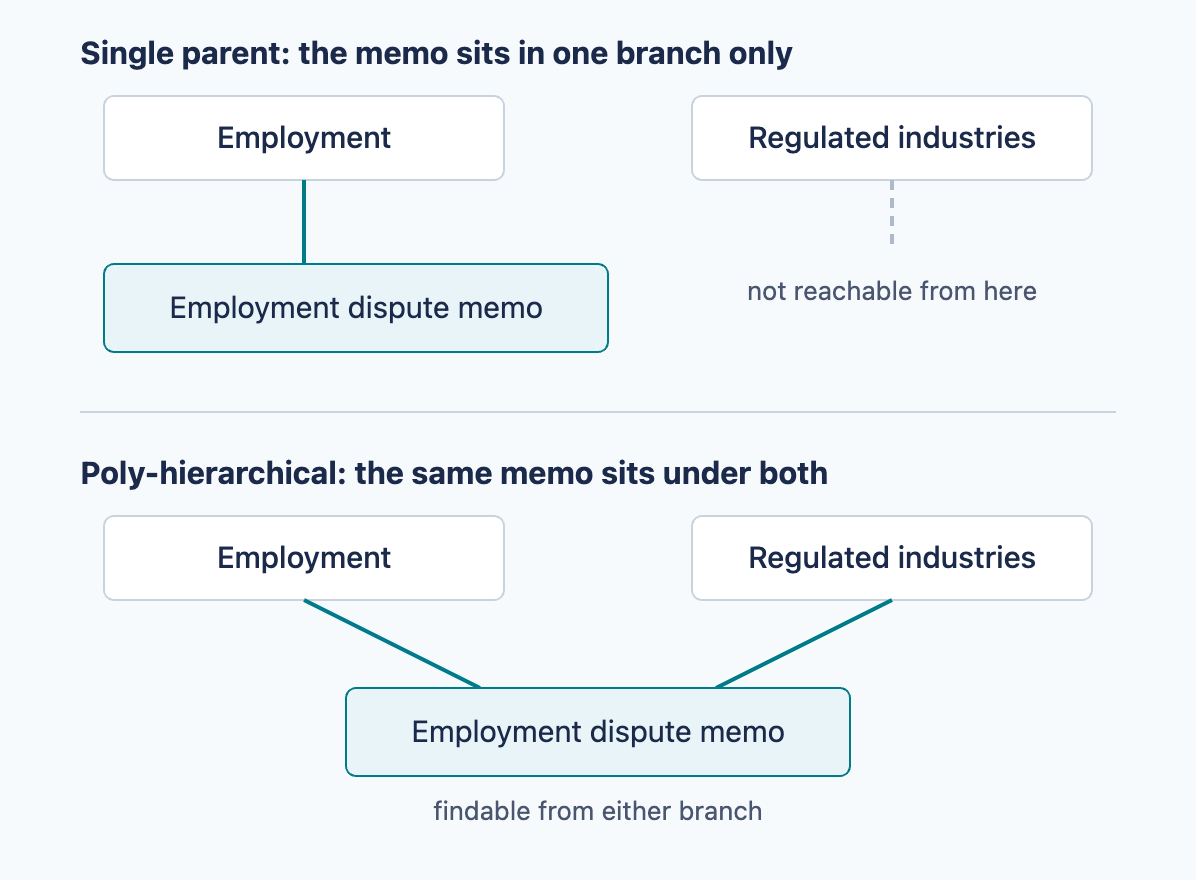
Legal collections may also span offices, locations and more than one classification scheme. In Sarah Sutherland’s profile of Soutron’s legal users, she notes that many law libraries hold unique collections of locally held documents, such as unreported court cases and internal research memos, and describes a client managing separate classification schemes for each office alongside a large contracts collection supporting a construction law practice. Soutron separates offices, libraries, and sublocations as three distinct tiers for that reason.
Access is governed through configured roles and permissions, so a record can be described consistently while remaining visible only to those entitled to see it. Sutherland’s article describes this as the detailed control required to share a collection partially with individuals outside the firm, which is what firms offering information services to clients and industry partners need.
Stinson LLP, a firm of 1,000 attorneys across 12 US offices with a nine-person library team, moved from a legacy integrated library system to a cloud-based platform and built a single knowledge portal connecting attorneys to curated resources, practice group pages, and external databases including Westlaw and LexisNexis, from one access point.
Where requirements sit outside the legal sector, our guide to metadata management software covers the broader category, and the legal knowledge management pillar explains where classification fits within a firm’s wider knowledge work.
Where to start if you are inheriting a scheme
If you are arriving at this subject with an existing scheme rather than a blank page, the standards are not the first question. The first question is what the existing scheme was built to answer, and whether anyone still knows.
Read the vocabulary before changing it. Establish what one record is supposed to represent, which fields people actually fill, and which terms have quietly become duplicates of each other. Only then is it worth deciding which published standard to map onto, and the routing table above is designed for exactly that moment. A scheme that is documented, owned and consistently applied will serve a firm better than a more sophisticated one that nobody maintains.
Frequently asked questions
What is the purpose of a legal taxonomy?
In a firm, a legal taxonomy exists so that people who did not create a document can still find it, so that work can be aggregated and reported on by practice area or matter type, and so that access rules can be applied consistently across a collection. In legal theory the term means something different: the classification of legal doctrine itself, such as where the boundary between contract and unjust enrichment should fall.
What are the four types of taxonomy?
Taxonomies are distinguished by structure rather than by a fixed count, so the number you see quoted varies. The forms that matter in legal information work are flat lists (a simple set of permitted values), hierarchical taxonomies (broader and narrower terms in a single tree), poly-hierarchical taxonomies (a term with more than one parent), and faceted schemes (several independent dimensions such as jurisdiction, practice area and document type applied at the same time). Legal collections commonly need the last two, because a single document rarely belongs in only one place.
What is the difference between a taxonomy and a thesaurus?
A taxonomy arranges terms into broader and narrower relationships. A thesaurus expresses further relationships on top, most usefully synonyms and variants, so that two people searching with different words reach the same concept. Where teams have settled on different terms for the same thing, that relationship is what closes the gap. The boundary between the two is not absolute, and some systems sit between them.
What is an example of a legal taxonomy?
SALI’s Legal Matter Specification Standard is the clearest industry-wide example. It provides shared terminology for classifying matters, time, documents and organizations, which is what allows a firm and its client to describe the same piece of work the same way. In law libraries, the Moys Classification and Thesaurus for Legal Materials and Library of Congress Classification Class K are the two long-established examples. Inside a firm, the everyday example is a practice-area scheme with controlled values for matter type, jurisdiction and document type.
What are the five types of metadata?
No single authority fixes the number, which is why you will see three, five or six quoted. The three that matter operationally in legal practice are descriptive, administrative and technical, covered in the table above. Lists of five usually add structural metadata, which records how the parts of a resource fit together, and preservation metadata, which records what is needed to keep a file usable over time. Both are more relevant to archival and digitized collections than to current working documents.
Is metadata discoverable in litigation?
Metadata is treated like other electronically stored information, so it falls within discovery where it is relevant to a claim or defense and proportionate to the needs of the case. Admissibility is then decided on ordinary evidentiary grounds rather than by any rule specific to metadata. The separate and more practical question is the form of production. Rule 34(b)(2)(E) allows production either as ordinarily maintained or in a reasonably usable form, and Rule 26(f)(3)(C) puts the form of production on the agenda for the parties’ discovery plan, which is where the question of which fields accompany a production is usually settled.
What is the difference between embedded metadata and managed metadata?
Embedded metadata lives inside the file, written there by the application that created it, and it moves with the file wherever the file goes. Managed metadata is held in a catalog or database that points at the record. Embedded metadata is harder to govern and easier to disclose by accident. Managed metadata can be corrected, reported on and controlled centrally, which is why collections that depend on reliable retrieval rely on it rather than on whatever the file happens to carry.
Should a firm adopt SALI if it already has its own matter codes?
Adoption rarely means replacement. The usual approach is to map existing internal codes to SALI concepts, so the firm keeps the terminology its people already use while gaining a shared vocabulary for exchanging information with clients and systems that expect it. Mapping delivers most of the value and avoids the disruption of replacing a working internal scheme outright.
Can a document management system handle this, or do you need a library system?
It depends on what you need to describe. A document management system organizes the firm’s own work product, usually around matters and clients, and handles that well. It is generally not built to catalog published material, journal subscriptions, licensed databases or physical holdings, which is where a library system is designed to work. Firms with meaningful external research collections often run both and decide which is authoritative for which fields. The distinction is set out in our guide to what a legal library manages.