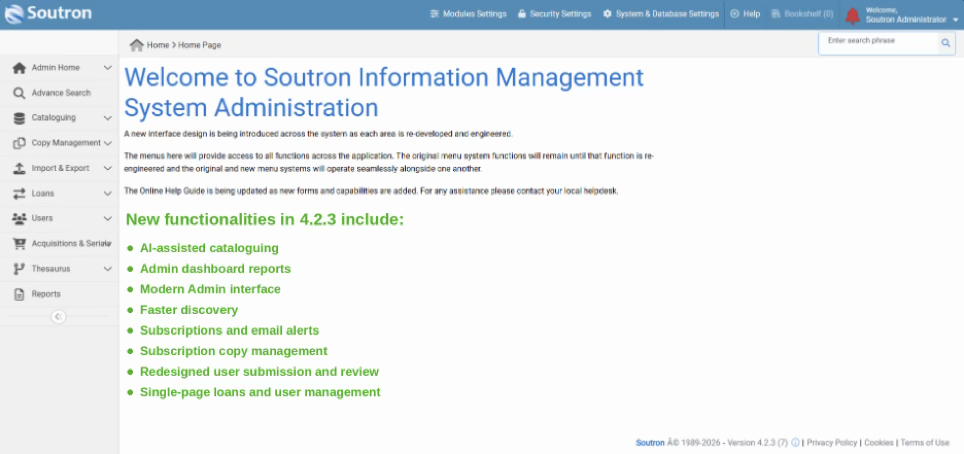
Most shortlists of library management software are not shortlists at all. They mix home cataloging apps, open source projects and enterprise platforms into one list, then rank them by review score. This guide is published by Soutron Global, and Soutron Global appears first because the list is ordered by fit for special, corporate, legal and research libraries, which is the audience it is written for.
That ordering principle matters, because a corporate research library, a 40-branch public system and an academic library with a large electronic resource budget need three different products, and a search for the best library management software will rarely tell you which of the three you are looking at. Every other system here is described from its own vendor documentation, linked at the end of each entry, with installation figures from an independent industry report.
Nine entries follow, one per vendor, each with what the system does well, where it sits, and one honest limitation. The selection criteria are published in full below, ungated.
If you are cataloging a home, church or classroom collection, this list is not for you. Libib, TinyCat, LibraryWorld and Librarika are built for personal and very small collections, and they are priced and designed for that use case in a way the systems below are not. The systems below are institutional platforms built around cataloging, circulation and collection management for an organization, and priced accordingly.
What counts as library management software, and what does not
Library management software is the system a library uses to catalog its collection, circulate items, manage acquisitions and serial subscriptions, and give users a way to search what the library holds. It maintains one authoritative record for every item, physical or digital.
In North America the same category is usually called an integrated library system, and this guide uses the two terms interchangeably. Four adjacent categories are routinely discussed as if they were one, which causes real confusion during procurement.
|
Term |
What it manages | Typical user | Where it stops |
| Library management system, also called an ILS | A catalog of held items, plus circulation, acquisitions and serials | Library and information staff |
It manages the collection, not the organization’s wider document estate |
|
Library services platform (LSP) |
Print and electronic resources in a single workflow, including licensing | Academic and research libraries | Built around subscription-heavy collections, less suited to physical-only libraries |
| Discovery layer | The search experience across the catalog and licensed content | End users and patrons |
It searches what it is pointed at, it does not manage or catalog anything |
|
Digital asset management |
Files, renditions and usage rights | Marketing, media and creative teams |
It tracks files and rights, not bibliographic description or circulation |
They also sit in a fixed relationship, and understanding it prevents most procurement mistakes. Cataloging produces the metadata. Authority control and a controlled vocabulary keep that metadata consistent over time. Discovery sits above the catalog and can only surface what has been described well enough to find. Migration is strongly influenced by the quality and consistency of that description: clean records make mapping and validation easier, while inconsistent local fields and authority data usually add work.
Our complete guide to an integrated library system covers how the modules fit together, and the guide to library management software works through the core functions by library type.
How we chose these systems
Six criteria, published here so you can disagree with them.
- Cataloging standards, including non-MARC records. Special libraries hold technical reports, standards and internal work product that has no MARC record and never will. Those collections depend on a controlled vocabulary and consistent local description, so a MARC-only system is not a candidate.
- The range of material the system can describe, from books and serials to electronic resources, non-book items and, in some settings, archival material.
- Circulation, acquisitions and serials in one place, since subscription management outside the catalog can create duplicate title maintenance.
- Discovery and end-user access, including whether the search interface can be branded and scoped by user group.
- Interoperability, particularly Z39.50 and SIP2.
- Migration and data portability: what you can export, in what format, and who maps the records.
This is not a review-score ranking, because satisfaction scores from small samples describe implementations rather than products, and it is not a claim that the system at the top is the best in the market. It is the one that fits the stated audience first. Vendor descriptions come from each vendor’s own documentation, reviewed September 2026, with one labeled exception in the Evergreen entry.
The shortlist at a glance
Use this to narrow to two or three candidates, then read the entries. If your library sits inside a company, firm or agency rather than serving the public, the corporate library solutions page sets out what that environment usually needs from the first column.
Two columns need a word of explanation. The mixed-collection column records what each vendor states on its own pages about describing material beyond standard MARC records, which is the question that decides most special and corporate library shortlists. It is not a verdict on capability: several of these systems almost certainly handle more than they advertise, and that is the problem, because you cannot confirm it from the marketing. The pricing column is short because not one of these vendors publishes an actual price. Installation figures are reported counts for 2025. They count deployments rather than libraries served or scale, so the metric favours vendors serving many small sites and says little about fit for a corporate or legal library, and several vendors did not respond to the survey, which is why some cells carry no figure.
|
System |
Best for | Deployment | Mixed and non-MARC collections | Reported installations, 2025 | Pricing |
| Soutron Global (Soutron ILS,, VERSO, Apollo) | Special, corporate, legal, government and research libraries; public libraries of all sizes and consortia through VERSO and Apollo | On cloud or on-premise. | Soutron ILS exchanges XML, MARC 21 and CSV, with a thesaurus and authority control for local description. VERSO and Apollo covers MARC authority control and ISO 18626 resource sharing | Apollo 1,005. VERSO 557. Soutron ILS not separately reported |
Single annual fee for the Soutron ILS covering software maintenance, support and hosting. |
|
Lucidea SydneyDigital |
Special libraries, digital-first collections | Not stated by the vendor | MARC import named; non-MARC description not stated | No published figure | Not published |
| SirsiDynix (EOS.Web, Symphony, Horizon) | EOS.Web for special, corporate, legal, medical, government and academic libraries. Symphony for public, academic, K-12, special and consortia | EOS.Web cloud or local install. Symphony local client, cloud or hosted | EOS.Web indexes more than 200 file types; no MARC standard named on the page | Symphony 2,077. EOS.Web 700. Horizon 597 |
Not published |
|
Ex Libris Alma |
Academic, research and health libraries, and consortia | Cloud | MARC 21 and linked data across print, electronic and digital resources | 2,835 | Not published |
| Innovative (Polaris, Sierra) | Public and university libraries, named on the vendor’s homepage only | Sierra cloud-ready with hosting options. Polaris not stated | No cataloging standard named on either product page | Polaris 599. Sierra 585 |
Not published |
|
OCLC WorldShare Management Services |
Academic libraries and consortia | Cloud | Built on WorldCat records; material not held there needs local description | 817 |
Not published |
|
Koha |
Any library type, with in-house capacity or a support contract | Self-hosted or vendor-hosted | MARC 21 and UNIMARC named; non-MARC description not stated | 1,710 via ByWater. 49 via Equinox | Free under GPL v3 or later, support contracted |
| Evergreen | Public, academic, school and special libraries, per Equinox | Vendor-hosted or self-hosted | Not stated by Equinox | 934 via Equinox |
Open source, services contracted |
|
FOLIO |
Academic libraries wanting a modular platform | Vendor-hosted | OAI-PMH, SIP2 and NCIP named by EBSCO; MARC not named | 343 via EBSCO. 41 via Index Data |
Free under Apache 2, services contracted |
Installation figures in the table above are from the Library Systems Report 2026 by Marshall Breeding, published by Library Technology Guides on 5 May 2026, and describe 2025 activity.
The 9 best library management systems in 2026
1. Soutron Global
Soutron Global builds library, archive and knowledge management systems for organizations where an information team owns the collection, and has done so for 50+ years. The Soutron integrated library system brings cataloging, circulation, authority control, acquisitions and serials into one place, with a thesaurus module that maintains built-in term relationships.
Best for: special, corporate, legal, government and research libraries whose collection includes material that has no MARC record. That is the dividing line this guide is built around, and it is where the published evidence is clearest: Requirements differ enough by sector that Soutron Global publishes them separately, including for law firm and legal library software.
What it does: cataloging with a thesaurus and authority control, circulation, acquisitions, serials, end-user submission and document review with metadata management tools. Data exchange runs through XML, MARC 21 and CSV, with integrations including SharePoint, Microsoft Active Directory and a RESTful XML API. Access is governed by configured roles and permissions.
Scale: Apollo is reported at 1,005 installations for 2025 and VERSO at 557. The 2026 Library Systems Report publishes no installed-base total for the Soutron ILS or MINISIS ILS.
Where it sits: three other Soutron Global lines serve adjacent library types. VERSO covers public libraries and consortia, with the SHAREit interlibrary loan platform alongside it. Apollo for public libraries holds fewer than 300,000 items, reported at 1,005 installations for 2025, and Artemis for K-12 school libraries. The side-by-side comparison sets the two main library options out in detail. Pricing and deployment differ by product, so the single annual fee above applies to the Soutron ILS. The practical effect of that range for a buyer is that a change in the organization’s shape, a new site, a merged collection, a school or public service added, does not automatically mean a new tender.
Pricing: a single annual fee covering software maintenance, support and hosting, with data migration and training charged as a fixed one-time fee.
Proof: Tim Wales, Head of Library and Information Services at Rothamsted Research, states: “As we already used EndNote for collecting publication records, thanks to Soutron it now takes half the time it did previously to add them to the LMS.”
Limitation: Soutron Global is built for organizations where a library, knowledge or information team owns the collection and the cataloging. A public branch network needing patron services at scale is served by Apollo and VERSO rather than the Soutron ILS, and a large academic library running a licensing-driven print and electronic workflow will find a library services platform a closer fit.
2. Lucidea SydneyDigital
SydneyDigital is Lucidea’s integrated library system for special libraries, and it is the closest comparison to Soutron Global for this audience. Lucidea positions it for digital-first special libraries of varying sizes and budgets, naming law firms, medical libraries, government libraries, NGOs, corporate libraries and research organizations.
Best for: special libraries, particularly those whose collection is mostly digital. Lucidea publishes no public, school or consortium messaging.
What it does: cataloging including rapid data entry, circulation, serials and e-journal subscription management, Active Directory and SharePoint integration, federated search across third-party content, request management with end-to-end tracking, and an analytics dashboard. Lucidea also markets Presto and PrestoWorks, which add faceted search, social tagging, SharePoint web parts and SAML authentication, with PrestoWorks offered as SaaS only.
Scale: no published figure. The 2026 Library Systems Report records that Lucidea did not respond to its survey.
Pricing: not published.
Limitation: the SydneyDigital page names MARC record import and no other interchange standard, so if Z39.50 retrieval or SIP2 self-service matters to your workflow, confirm it directly with the vendor rather than assuming it. Note also that SydneyEnterprise, a name you will still see in older comparisons, does not appear in Lucidea’s current product list.
Source: Lucidea SydneyDigital, reviewed September 2026.
3. SirsiDynix
SirsiDynix runs three relevant systems and which applies to you depends entirely on your library type. EOS.Web is the special library line and the one most readers here will want to compare. Symphony is the large-scale public and academic platform. Horizon remains in active development, extended through the BLUEcloud module family.
Best for: EOS.Web for special, corporate, legal, medical, government and academic libraries. Symphony for public, academic, K-12 and consortia.
What it does: EOS.Web covers bibliographic, authority and item cataloging, serials, circulation with interlibrary loan, acquisitions, an OPAC, a Z39.50 server, electronic resource management, an indexer covering more than 200 file types, RFID and course reserves, with SIP2 self-check support. SirsiDynix states that EOS.Web is currently authorized with FedRAMP, which matters for US federal procurement. Symphony covers the same core modules at consortium scale, with offline functionality.
Scale: Symphony 2,077 installations, EOS.Web 700 and Horizon 597, all reported for 2025.
Pricing: not published.
Limitation: the breadth means you are buying into a portfolio rather than a single product, and the EOS.Web page names no MARC standard despite describing full bibliographic, authority and item cataloging. Confirm MARC handling and the release cadence for the special library line in writing.
Source: SirsiDynix EOS.Web and SirsiDynix Symphony, reviewed September 2026.
4. Ex Libris Alma
Alma is a library services platform rather than a traditional ILS, built to manage print, electronic and digital resources through one workflow. It is the most widely installed system in this guide.
Best for: academic, university, research and health libraries, and academic consortia.
What it does: unified management of print, electronic and digital resources, cataloging and classification, circulation, digital resource management, reporting through Alma Analytics, resource sharing and interlibrary loan, metadata enrichment using AI, and more than 200 APIs. It supports MARC 21 and linked data, and pairs with Primo for discovery.
Scale: 2,835 installations reported for 2025, the largest installed base in this guide.
Pricing: not published.
Limitation: Ex Libris carries no special library, corporate or law firm messaging on its Alma pages, and the platform is built around managing print and electronic resources together. A library with a mostly physical collection and no electronic resource licensing workflow should ask how much of that model it would actually use.
Source: Ex Libris Alma, reviewed September 2026.
5. Innovative Polaris and Sierra
Innovative markets two systems. Neither product page names a target library type, although the company’s homepage names public and university libraries. Polaris centers on the patron-facing catalog and staff workflows, while Sierra is positioned as a services platform covering print and electronic resources together.
Best for: public and university libraries, which are the only types Innovative names, and on its homepage rather than on either product page.
What it does: Polaris covers staff workflows, a brandable patron catalog, faceted discovery and integrated electronic resources, and publishes a fully documented Microsoft SQL database schema plus APIs for third-party vendors, which is worth weighing if you intend to build your own reporting. Sierra runs staff functions in a browser, manages print and electronic resources together, and covers collection management from budgeting through weeding. Innovative also markets the Vega discovery products.
Scale: Polaris 599 installations and Sierra 585, reported for 2025.
Pricing: not published.
Limitation: neither product page names a library type or a cataloging standard, so anything you need confirmed about MARC handling, Z39.50 or SIP2 has to come from the vendor directly. Neither is positioned for special, corporate or law libraries.
Source: Innovative Polaris and Innovative Sierra, reviewed September 2026.
6. OCLC WorldShare Management Services
WorldShare Management Services is a cloud library services platform built on WorldCat, which is also its main differentiator and its main constraint. Cataloging draws on shared WorldCat records rather than starting from scratch.
Best for: academic libraries and consortia. The customers named on OCLC’s own page are almost entirely universities.
What it does: OCLC frames the platform around acquiring, describing, discovering, circulating, sharing and analyzing the collection, with a single interface to search the full collection and subscribed databases, locate items held by other libraries, view availability, place holds and manage patron accounts.
Scale: 817 installations reported for 2025.
Pricing: not published.
Limitation: the WorldCat foundation is a real advantage for a library whose material is well represented there, and a real limitation for one whose material is not. Material with no existing WorldCat record, which often includes internal reports, technical documentation and grey literature, still has to be described locally, and that is the point at which the platform’s main advantage stops applying.
Source: OCLC WorldShare Management Services, reviewed September 2026.
7. Koha
Koha describes itself as the first free and open source library system, and on the numbers it is one of the most widely deployed systems in this guide. It is free to license and it is not free to run, which is the distinction that decides whether it belongs on your list.
Best for: libraries of any type with in-house technical capacity or a support contract with a vendor such as ByWater Solutions or Equinox.
What it does: acquisitions, circulation, cataloging, serials, authorities management, flexible reporting, offline circulation, full-text searching, an OPAC and self-checkout interfaces. Its documentation names MARC 21, UNIMARC, Z39.50, SRU, SIP2 and NCIP, one of the fuller standards lists published by any vendor here.
Scale: 1,710 installations supported by ByWater Solutions and 49 by Equinox, reported for 2025. Release cadence is active, with three maintenance releases issued on a single day in August 2026.
Pricing: the software is licensed under GPL version 3 or later at no cost. Support, hosting, migration and development are contracted separately and no vendor publishes a rate.
Limitation: the total cost sits almost entirely in the parts nobody publishes. If your organization has no systems librarian and no budget line for a support vendor, the license saving disappears into staff time. We have worked through where the real costs land in a comparison of open source and commercial library software.
Source: Koha Community and ByWater Solutions, reviewed September 2026.
8. Evergreen
Evergreen is an open source library system. Its commercial support in North America comes principally from Equinox Open Library Initiative, and the description below is drawn from Equinox rather than from the Evergreen project, whose own site was not reachable when this guide was compiled.
Best for: public, academic, school and special libraries, which are the four types Equinox names.
What it does: Equinox Open Library Initiative is a 501(c)(3) nonprofit and the successor to Equinox Software. It provides consulting, migration, development, hosting, support and training around Evergreen, alongside Koha, VuFind, Aspen Discovery and CORAL, and it is an institutional member of the Evergreen Project.
Scale: 934 installations supported by Equinox, reported for 2025.
Pricing: open source, with services contracted.
Limitation: Equinox is a services organization around software it does not own, so continuity and support terms depend on the partner you contract with rather than on a single vendor relationship. Equinox also names no interchange standards on its site, so MARC, Z39.50 and SIP2 handling has to be confirmed directly.
Source: Equinox Open Library Initiative, reviewed September 2026. The Evergreen project site was not reachable at the time of review.
9. FOLIO
FOLIO, short for Future of Libraries is Open, is an open source library services platform built as modular apps rather than a single monolithic system. EBSCO is the main commercial provider.
Best for: academic libraries that want a modular platform and are comfortable with a services relationship rather than a license.
What it does: through EBSCO, circulation, cataloging, acquisitions and electronic resource management, delivered as modular apps from a marketplace, with integrations to the EBSCO Knowledge Base, EBSCO Discovery Service, GOBI and EBSCONET. EBSCO hosts it on AWS with a stated 99.95% uptime and states ISO 27001 compliance. Named standards include OAI-PMH, SIP2 and NCIP. Development is active, with the Sunflower release in March 2026 and Trillium in July 2026.
Scale: 343 installations supported by EBSCO and 41 by Index Data, reported for 2025, a combined 384 and the smallest here. EBSCO describes FOLIO as the first new library services platform launched in over ten years.
Pricing: the software is licensed under Apache 2 at no cost, services are contracted, and no rate is published.
Limitation: FOLIO’s own community site names no modules, no standards and no license, so almost every concrete claim about FOLIO has to be attributed to a service provider rather than to the project. EBSCO’s FOLIO material addresses academic libraries only.
Source: EBSCO FOLIO and folio.org, reviewed September 2026.
Two categories this shortlist does not rank
Follett Destiny is widely used in K-12 school libraries, and school library procurement runs on different budget cycles and different requirements. The 2026 Library Systems Report records that Follett did not respond to its survey, as did Lucidea and LibLime, so no installation figure is published for any of them.
Libib, TinyCat, LibraryWorld and Librarika serve home, church, classroom and very small collections. They are named at the top of this guide for exactly that reason.
Comparison lists rarely show how a system behaves once it is handling your own cataloging, loans and reporting every day. Our white paper on library workflows in the digital world sets out the routines worth testing during a trial.
What changed in the library systems market in 2026
Three market conditions matter when building a shortlist in 2026: vendor ownership has consolidated, so several apparently independent systems now sit in the same corporate group; open source systems represent a substantial share of the reported installed base; and standards support is documented unevenly across vendor websites. Each affects a procurement decision, and none shows up in a feature comparison.
Consolidation has reduced the number of independent vendors: The 2026 Library Systems Report describes a single Clarivate library software group spanning both the Ex Libris and Innovative portfolios, which places Alma, Primo, Sierra and Polaris inside the same corporate group. Harris, an operating company of Constellation Software, acquired SirsiDynix from ICV Partners in December 2024. Soutron Global acquired MINISIS in late 2024, Auto-Graphics in March 2025, bringing the VERSO ILS and the SHAREit interlibrary loan platform, and Biblionix in August 2026, bringing the Apollo and Artemis systems. That last one closed after the 2026 Library Systems Report was published, which is a useful reminder that a market map goes out of date between annual reports. A shortlist of four apparently independent systems can easily turn out to be two negotiating positions.
What that should change about the questions you ask: Shared ownership does not make two systems equivalent, and it is not a reason to rule either out. It is a reason to ask who controls the product roadmap for your specific system rather than for the portfolio, whether support teams are shared across the group, how renewal terms are structured when the same parent holds an alternative you might move to, and what the stated plan is if the group consolidates overlapping platforms. Those four answers are worth more at contract stage than any feature comparison.
Open source accounts for a substantial share of the installed base: Koha supported by ByWater Solutions has more installations than any commercial system here apart from Alma and Symphony. That is worth stating plainly even though it does not favor us: open source is a mainstream option, not a fringe one, though that does not make it the right answer for a two-person corporate library.
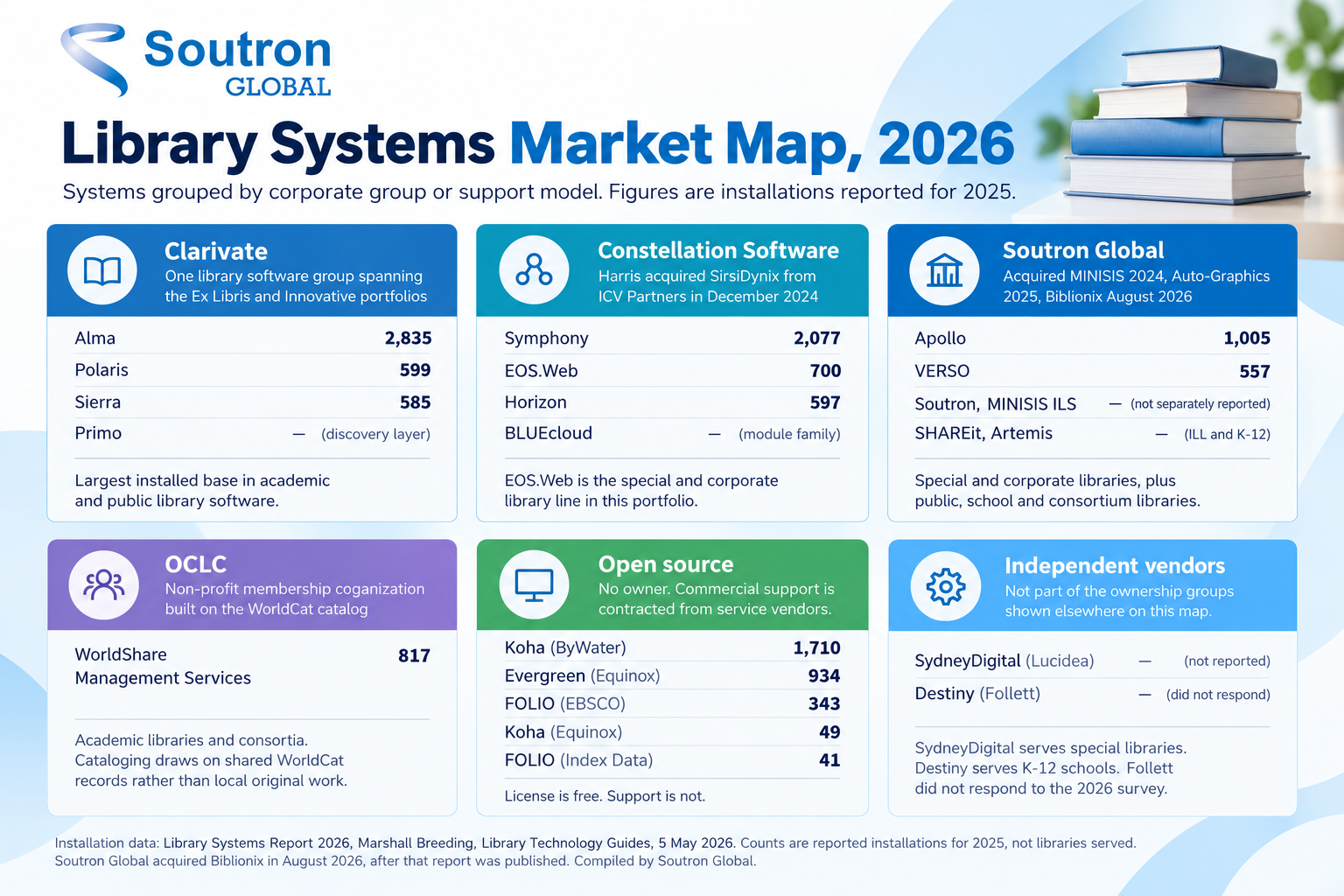
Most systems on a typical shortlist belong to one of six groups.
Standards support is documented unevenly. The Symphony, Horizon, Polaris, Sierra and WorldShare Management Services pages name no interchange standards at all, and Lucidea’s SydneyDigital page names MARC import only. That does not mean those systems lack MARC 21 or Z39.50 support. It means you cannot confirm it from the marketing, so get it in writing.
How much does library management software cost?
None of these vendors publishes a price. What varies between them is the shape of the commercial model, and there are three in this market.
The per-user or tiered subscription charges by named staff users, collection size or branch count, so costs rise in steps as a library grows. The all-inclusive annual fee bundles software, support and hosting into one figure, which simplifies budgeting but requires care in comparing what each bundle contains. The open source model charges nothing for the license and everything for the services around it, so hosting, support, upgrades and staff time become the real budget line.
The items outside the license are the ones most often missed. Data migration, configuration, training and any self-service hardware are usually quoted separately, and migration cost is driven by the state of your existing catalog records rather than by the software you are moving to. Ask every vendor for migration and training as separate line items before comparing annual fees, because a low subscription with a high implementation charge and a higher subscription with migration included can be the same three-year number.
| Getting a quote you can actually compare If Soutron Global is on your shortlist, we will quote the annual fee, the migration and the training as three separate figures, and tell you what drives each one before you commit to anything. Compare the Soutron and MINISIS library options, or talk to us about your requirements. |
Frequently asked questions
Which library systems are owned by the same company?
Several systems that look independent share a corporate owner. The 2026 Library Systems Report describes a single Clarivate library software group covering both the Ex Libris and Innovative portfolios, which places Alma, Primo, Sierra and Polaris in the same group. SirsiDynix, which markets Symphony, Horizon and EOS.Web, was acquired by Harris, an operating company of Constellation Software, in December 2024. Soutron Global acquired MINISIS in late 2024, Auto-Graphics in March 2025 and Biblionix, which produces Apollo and Artemis, in August 2026.
What system for cataloging do most libraries use?
There is no single cataloging software that most libraries use, because the product varies by library type. What is shared is the record standard. MARC 21 is the dominant standard for bibliographic and authority data, maintained by the Network Development and MARC Standards Office at the Library of Congress. Z39.50, standardized as ANSI/NISO Z39.50 and ISO 23950, is the separate protocol systems use to search and retrieve those records from other catalogs. Special libraries are the common exception, because technical reports, standards and internal work product frequently have no MARC record available.
Is open source library management software free?
The license is free. Koha is released under GPL version 3 or later and FOLIO under Apache 2, so there is no software cost. Everything else is not free, including hosting, implementation, support contracts, version upgrades and the staff time to run the system. Most institutions contract a support vendor, and none of those vendors publishes a rate, so the only way to compare an open source option against a commercial one is to price the support contract alongside the license fee.
Can you move your catalog records from one library system to another?
Usually yes, and the format matters more than the vendor. MARC 21 records export cleanly between systems that support the standard, which is why MARC portability is worth confirming in writing before you sign. The harder parts are non-MARC records, local fields, authority files, patron data and circulation history, which often need mapping rather than straight export. The variable that drives migration cost is the consistency of your existing records, not the software you are moving to.
What software should I use for a home or personal book collection?
Libib, TinyCat, LibraryWorld and Librarika are designed for personal, church and classroom collections, and any of them will catalog a few thousand books quickly and cheaply. The institutional systems in this guide carry acquisitions and authority control functions that a personal collection has no use for, and they are priced for organizations with a library team.
Choosing the right fit
The decision that matters most here is not which vendor, it is which category. A system built for a 40-branch public network and one built for a two-person corporate research library share a vocabulary and very little else, and a mismatch is rarely discovered at demo stage. It surfaces during migration.
There is no single best library management software for every library, only the system that fits the collection you hold and the team that will run it. Three questions narrow this list faster than any feature comparison. What proportion of your collection has no MARC record, and can the system describe it properly? Who owns the taxonomy once the system is live, and does that person exist in your organization today? And what happens to your records if you leave, in what format and at whose cost? Answer those honestly and most of the nine will rule themselves out, which is the point of a shortlist.
To see how your own records and taxonomy behave in a live system rather than in a feature table, request a demonstration and bring a sample of your catalog to it.
Sources
- Library Systems Report 2026: Innovation under constraint, Marshall Breeding, Library Technology Guides, 5 May 2026. Source for every installation figure, the acquisition dates and the corporate groupings in this article. Figures are reproduced with attribution; the full report contains a great deal more analysis than is summarised here and is worth reading in full.
- Soutron Global Acquires Biblionix, 17 August 2026. This acquisition closed after the Library Systems Report was published.
- MARC Standards, Network Development and MARC Standards Office, Library of Congress.
- Z39.50 International Standard Maintenance Agency, Library of Congress.
- Product capabilities, library types, deployment models and pricing models were taken from each vendor’s own current product documentation, reviewed in September 2026. The exception is Evergreen, whose project site was not reachable at the time of review; that entry is sourced to Equinox Open Library Initiative and is labeled as such.
Trademarks
All product and company names mentioned in this article are the trademarks or registered trademarks of their respective owners, and are used here for identification and comparison purposes only. Their use does not imply any affiliation with, endorsement by, or sponsorship of Soutron Global by those owners.
Alma and Primo are products of Ex Libris. Sierra, Polaris and Vega are products of Innovative Interfaces. Symphony, Horizon, EOS.Web and BLUEcloud are products of SirsiDynix. WorldShare Management Services and WorldCat are services of OCLC. SydneyDigital, Presto and PrestoWorks are products of Lucidea. Koha and Evergreen are open source projects, supported commercially by ByWater Solutions and Equinox Open Library Initiative, which also supports Aspen Discovery, CORAL and VuFind. FOLIO is an open source project supported by EBSCO Information Services and Index Data; EBSCO Discovery Service, GOBI and EBSCONET are services of EBSCO. Destiny is a product of Follett. Libib, TinyCat, LibraryWorld and Librarika are the products of their respective owners. SharePoint and Active Directory are products of Microsoft. EndNote is a product of Clarivate. Soutron, MINISIS, VERSO, SHAREit, Apollo and Artemis are products of Soutron Global. MINISIS, Auto-Graphics and Biblionix are Soutron Global companies.
Product descriptions and installation figures are sourced as set out under Sources above, with each vendor’s own documentation linked at the end of its entry. If you represent one of the organizations named here and believe anything in this article is inaccurate or out of date, contact us at marketing@soutron.com and we will review it and correct the article where correction is due.