Many libraries still rely on legacy library management systems that struggle to keep up with today’s needs.
Staff may spend excessive time on manual data entry and duplicate processes for cataloging and maintaining authority control records. This leads to poor user discovery and search results.
Libraries need to update their library management software to support users’ and staff’s operational needs.
A modernized LMS addresses the limitations of legacy library systems by delivering accurate search, scalability, security, and other user-centric features.
This article explores the benefits of library management software for public, academic, and special libraries.
6 Key Benefits of Using a Modern Library Management System
Switching to a modern, fully featured library management system can benefit your library in several ways.
1. Streamline Library Staff Workflows
According to the Institute of Museum and Library Services, circulation of physical materials reached 4.37 items per person, while digital circulation climbed to 1.68 per person for ebooks, electronic audio, and electronic video.
As library usage grows, staff workloads increase.
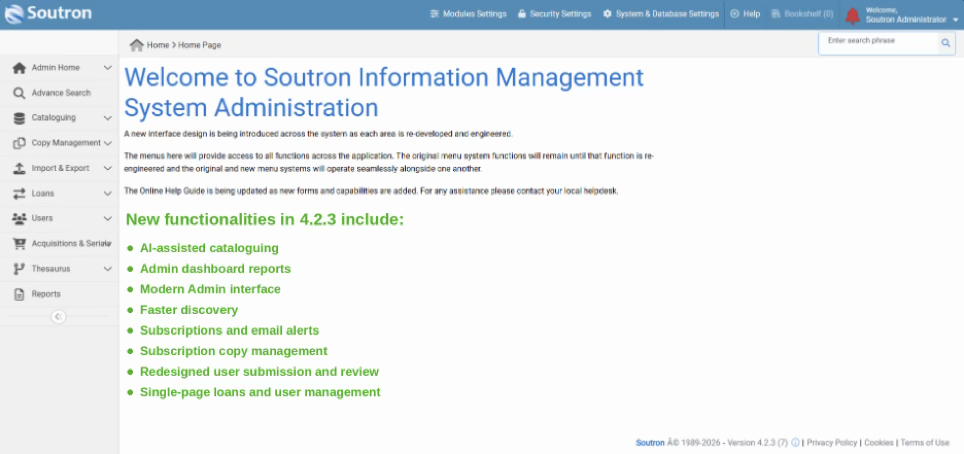
Modern library management software helps libraries manage this demand through preconfigured automation capabilities.
Tasks that once required manual steps can now run automatically. Instant checkout and returns, automatic fine calculations, and real-time inventory updates reduce routine work for library staff.
2. Enhance User Experience
A modern library management system gives patrons a user-friendly online catalog with custom search filters, clear availability status, and real-time updates. They can place holds, renew items, freeze holds, and pay fines without calling the library.
Modern systems are also accessible from mobile devices. Both patrons and library staff can use the platform on the go.
3. Support Scalability
Legacy systems often struggle as your library grows. Adding a new branch may require hardware upgrades or complex reconfiguration. Higher circulation can slow performance. And expanding digital collections often involves separate tools.
A modern SaaS-based LMS is designed to scale with your library. It handles increased usage without local server limits.
A scalable library management system lets you manage multiple branches, expand collections (whether print, digital, or physical), and support changing user requirements.
You also don’t need major system overhauls since software updates happen automatically and are handled by the provider.
4. Protect Sensitive Data
Your library should keep names, addresses, borrowing history, and payment details secure.
A modern LMS provides industry-leading security measures to protect sensitive data. It manages your database safely in the cloud and supports secure authentication.
Some library management systems also offer role-based permissions to limit access to sensitive information.
With stronger access controls and secure cloud hosting, you reduce the chance of data breaches and protect patron trust.
5. Reduce Operational Costs
Library management software can lower operational costs in several ways.
First, the system reduces the time staff spend on repetitive and tedious tasks. For example, checking the inventory can take hundreds of hours if librarians have to review items one by one.
RFID technology built into modern LMS gives staff the ability to scan entire shelves at once.
These labor savings help libraries lower operating costs. They can use the time saved to improve collections or expand services for customers.
Better inventory tracking also cuts down expenses by preventing lost materials. Staff can use RFID technology to automate the tracking and movements of physical assets.
Lastly, a modern SaaS-based LMS is securely hosted on the cloud to reduce hardware and maintenance costs. Libraries don’t need to maintain large local servers.
6. Improve Reporting
Libraries often need clear data on circulation, programming, and resource usage. Staff use reports to justify funding requests, understand community needs, or support collection development.
Modern library management software includes reporting tools that make this process easier. Staff can generate reports on circulation, user activity, and collection usage using established formats.
These reports provide useful insights into how patrons interact with library resources. Staff can see which books, journals, research papers, or digital materials are popular and which items receive less attention. That makes it easier to decide what to purchase, replace, or remove from the collection.
For public libraries, reports show government officials, donors, and the public how funding is spent. These help maintain local funding and secure future financial support.
Who Can Benefit From Modern Library Management Software?
Modern library management software helps varying types of libraries manage large collections and support growing user needs.
Public Libraries
Public libraries serve communities of all sizes and types. As the name suggests, they provide services to the general public and local businesses.
Many public libraries organize programs and collections for children, teens, and adults to support learning and reading across all age groups.
These libraries often manage high circulation and a steady flow of visitors. They use a modernized LMS to automate routine tasks, such as cataloging, inventory tracking, loan processing, and patron management.
With fewer manual tasks to handle, librarians have more time to focus on engaging with the community. For example, they can organize story times, book clubs, author talks, and crafting workshops.
Modern library management systems also enable patrons to search catalogs faster, place holds, and manage their accounts more easily.
Special Libraries
Special libraries operate within organizations, such as law firms, hospitals, museums, and private companies.
Special library collections often include research files, technical documents, and restricted proprietary content.
A modernized library management system helps special libraries provide secure access, maintain accurate records, and track resource usage.
Some platforms also offer a customizable search portal that enables corporate users to find what they need faster.
Highly Customizable and Efficient Library Management With Soutron
Soutron Global provides SaaS library management software solutions that equip both special libraries and public libraries with comprehensive tools for managing unique collections, handling diverse user groups, and providing essential library services.

These solutions give organizations the flexibility to create tailored information centers, knowledge hubs, and search portals or OPACs aligned with their specific research and information needs.
Designed for libraries of all types and sizes, Soutron Global’s web‑based platforms offer preconfigured automation capabilities, including core cataloging, reporting, and virtual shelf browsing. At the same time, it supports customizable workflows that match the way each library operates.
Highly flexible, secure, and scalable, Soutron Global’s solutions spotlight physical and digital collections in ways that support modern discovery expectations and improve overall user experience.
With ongoing updates, enhancements, and maintenance included, Soutron Global helps libraries streamline resource management, improve information discovery, and deliver stronger services to both public patrons and corporate users.
Request a demo today to see how you can transform your library management!
FAQs About Library Management Software
What is library management software?
Library management software, also known as an integrated library system, is digital technology that helps libraries manage daily operations. It handles cataloging, circulation, patron records, reporting, and digital resources in one place. Modern library management software often runs in the cloud and supports all types of collections (print, physical, and digital).
What is the best integrated library system?
The best integrated library system depends on your library type, size, budget, and service needs.
Soutron Global’s library management systems are used by public and organizational special libraries around the world. Our solutions are among the top choices due to flexible design options that adapt to each library’s unique workflows and customer needs.
How to choose the right library management software?
First, identify what’s not working in your current library management system. Are reports difficult to generate? Is lending of non-traditional items (e.g., board games or musical instruments) disconnected from your catalog? Make a list of must-have capabilities, such as ILL integration, clear reporting, and thesaurus or authority control.
Then, compare vendors based on how well their system fits your daily operations and budget. Don’t forget to ask about data migration, installation costs, training, and ongoing support before making a decision.
How is library software delivered?
Library software can be delivered through cloud-based SaaS models or on-premises installations. Cloud-based library software is hosted by the vendor and accessed through a browser. On-premise library systems are installed on local servers and require internal IT support.