Knowledge Management and Artificial Intelligence Cornerstones: Special Libraries and Archives
The Role of Special Libraries and Archives in Knowledge Management and Artificial Intelligence
Within the knowledge management and artificial intelligence ecosystem, special libraries and corporate archives serve a critical role in unifying and capturing, organising, and storing an organisation’s knowledge as intellectual capital, serving as an authoritative source for accurate, consistent, up-to-date knowledge assets.
In the context of knowledge management and artificial intelligence, special libraries and archives have expanded their role beyond traditional knowledge management systems, which are often static repositories, to support AI powered knowledge management, where AI analyses, searches, and synthesises organisational knowledge at scale.
Integrating AI in knowledge management systems turns static repositories into dynamic, intelligent ecosystems that improve knowledge discovery and access.
Capturing knowledge in a library or archive database that is authoritative, proprietary and tagged with accurate metadata keywords can facilitate the sharing of know-how that spurs innovation. Without the authoritative knowledge base that exists within the special library or archive, KM and AI systems will be prone to what is naively termed ‘hallucinations’, or what we used to say ‘misleading, not accurate, or authoritative’.
Knowledge Management Strategy: Challenges and Solutions
Two of the primary challenges with knowledge management are that traditional systems often depend on manual processes and manual effort, while ai knowledge management can reduce those limits by automating repetitive tasks. Questions that should be asked: Are both explicit knowledge and tacit knowledge being captured and accurately stored as structured knowledge, and can teams identify knowledge gaps before those knowledge gaps affect decisions?
AI can continuously capture institutional knowledge from emails, chats, and meetings so critical know-how is not lost when employees leave. AI also analyses internal communications and project histories to map skills, identify internal subject matter experts, and reduce routine tasks tied to finding the right people and answers. Does management value the accomplishment of organisational goals enough to provide a secure, centralised library or archive repository that enforces consistent metadata terminology, automatically tags, updates, and organises content across structured and unstructured data, and supports distributing knowledge more efficiently to build a knowledge base while cutting repetitive tasks?
AI-driven knowledge management uses natural language processing, natural language processing NLP, machine learning, and AI models to surface relevant information and relevant knowledge more effectively by analysing and categorising vast amounts of data so the most relevant information is readily available to users. It can also identify hidden patterns and emerging trends across large volumes of unstructured enterprise data. Management culture and company goals present some of the leading knowledge management challenges, and success also depends on a clear knowledge strategy and knowledge management strategy, strong data quality, workflow integration when integrating AI, and sound governance with change management.
Special Libraries and Corporate Archives: Building a Knowledge Sharing and Knowledge Management Culture for the Future
In today’s knowledge-driven economy, implementing a knowledge-based culture through a centralised special library or corporate archive system is key. An AI knowledge management solution is one of the knowledge management tools that uses artificial intelligence to optimise the storage, retrieval, knowledge sharing, and knowledge creation of enterprise knowledge resources within knowledge management systems, while automating the organisation and categorisation of vast amounts of unstructured data so it is easier for employees to access and use.
With AI powered search, intelligent search uses semantic search, natural language, and natural language processing to understand human language and user intent, so users can ask questions conversationally rather than relying on exact keyword matching and still find more relevant results.
This reduces time spent searching because AI-driven systems analyse and categorise large volumes of data so the most up-to-date and pertinent information is readily available, improving response times, retrieval accuracy, and overall operational efficiency.
AI-powered knowledge management can also personalise insights from previous interactions, historical data, and customer data to improve collaboration, customer satisfaction, and faster responses. Integrating AI into knowledge management systems also improves the accuracy and consistency of information, ensuring employees can act on the most relevant and current knowledge for better decision-making and problem-solving. Automated content summarisation can also condense long reports and articles into bullet points to accelerate executive decision-making.
For insight on overcoming the challenges of building a KM culture, download our comprehensive Information Management eBook, which provides a foundation that reinforces the fundamentals of information and knowledge management, the challenges faced in today’s knowledge management AI environment, along with strategies to use to build an information systems-based knowledge management culture that spurs innovation.
Knowing that your organisation’s knowledge and collective knowledge are kept accurate and trustworthy within a central knowledge base, and that their gathering and storage are based on strong knowledge management practices and effective knowledge management, is essential to reliable ai capabilities and generative ai outputs and helps avoid AI hallucinations.
AI tools and large language models can also be embedded into everyday workflows to surface relevant knowledge inside existing platforms, rather than only in a standalone database.
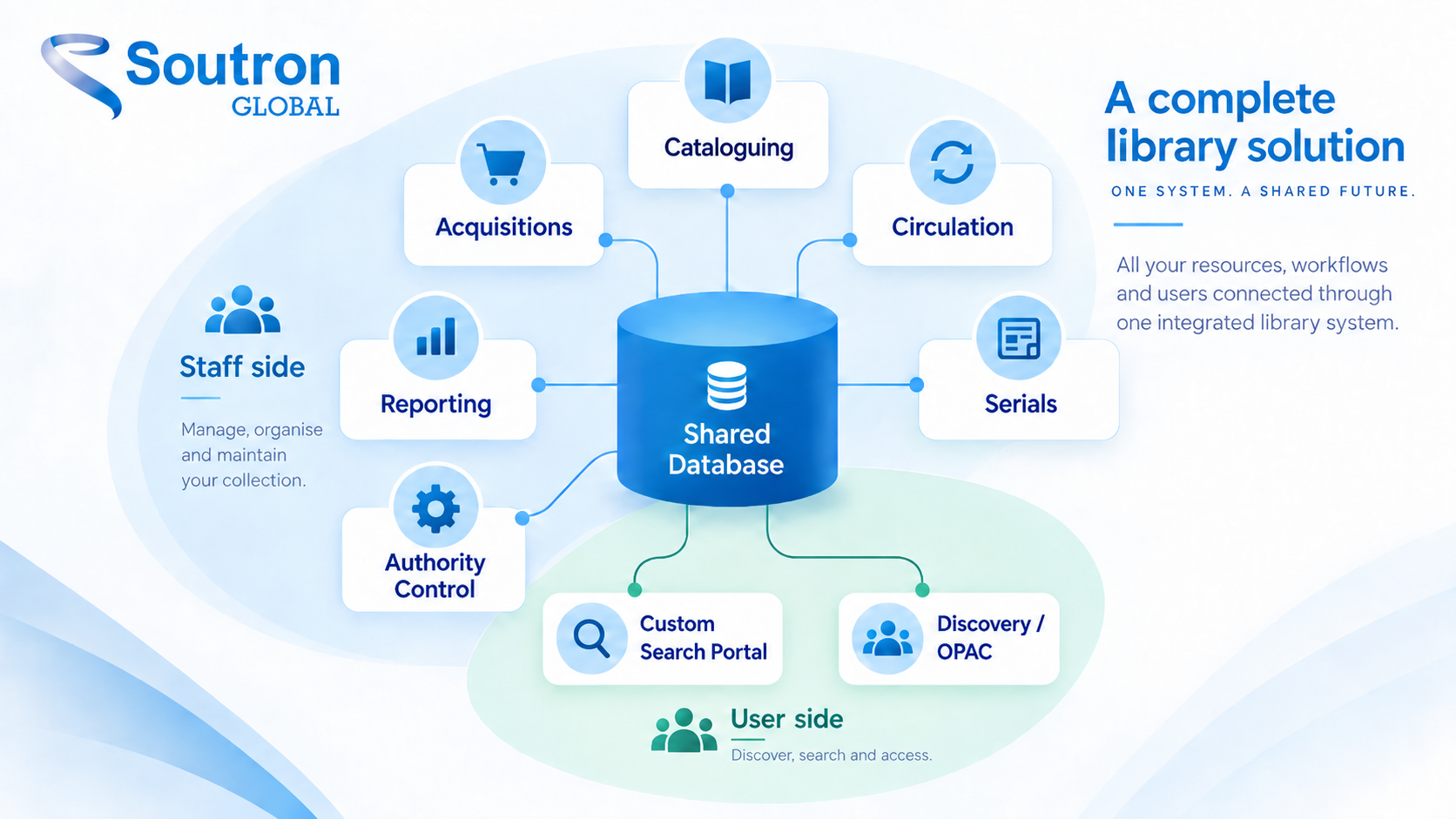
Access more information on how Soutron’s Discovery Services, Library and Archive Systems can help with your knowledge management and artificial intelligence initiatives by access the links below.
- Getting Started with Knowledge Management
- Soutron Selected for Knowledge Management at an International Global Law Firm
- Merging Knowledge Management and Librarianship
- Effective Information and Knowledge Management in the AI Era
Alternatively, book an online demonstration with us to discuss your ideas and explore how Soutron software could help you today!