Ask four people in the same organization what knowledge management means and you will often get four different answers. A search platform, to an IT director. The help center, to a customer support lead. Culture and behavior change, to a management consultant. To a librarian, archivist, or information manager it means description and retrieval, and the work of making sure that something written down once can be found again later by someone who had nothing to do with writing it.
Those answers are not equally right, and the difference is not academic. It decides which team owns the work, what the project is measured on, and what the organization eventually buys.
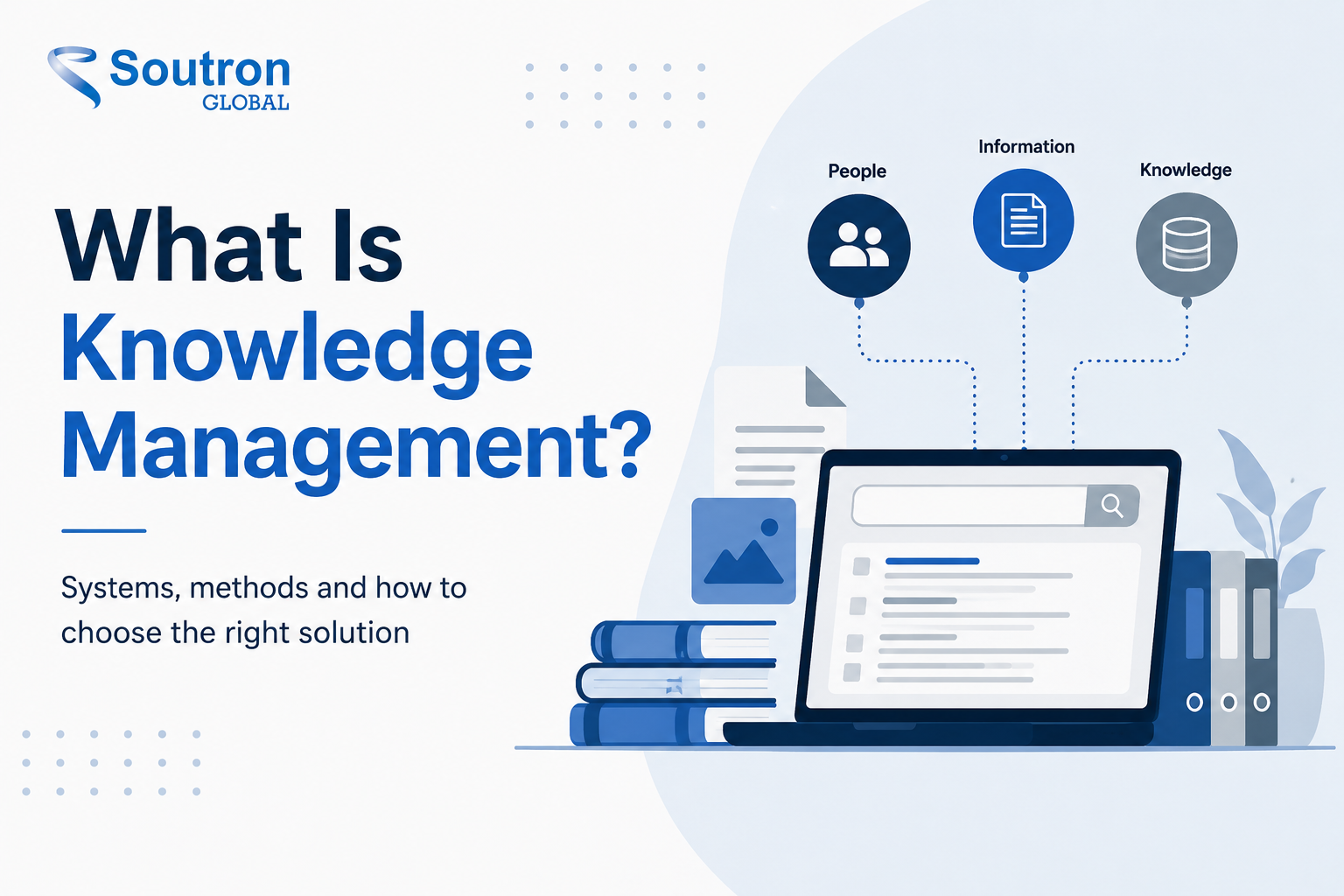
| Knowledge management is the organized practice of capturing what an organization knows, describing it so it can be found again, and making it available for reuse. It covers recorded material and the judgment held by individual staff, and it works through people, process, and systems rather than through software alone. |
This guide covers what the discipline includes, how it differs from information, document, and records management, what a knowledge management system does, which methods organizations genuinely use, which standards apply, and how to evaluate a system if you get that far.
What does knowledge management actually cover?
The discipline works on two kinds of material. Explicit knowledge has already been written down: reports, procedures, completed research, catalog records, past project documentation. Tacit knowledge has not, and often cannot easily be, because it lives in the judgment of experienced staff. Knowing which supplier is reliable, or which past project a new problem resembles, is tacit knowledge. Between the two sits implicit knowledge, the practical know-how that could be recorded but never has been because nobody thought to ask. The distinction sounds theoretical until somebody retires, and it is worked through in detail in our guide to how tacit and explicit knowledge behave inside a law firm.
Every organization manages knowledge somehow. What separates them is whether it happens by design or by accident, and whether the institutional knowledge built up over years survives a reorganization, a merger, or a single resignation. That is the whole argument for treating this as a discipline rather than as a habit.
Any serious effort has three parts: the people who hold and use the knowledge, the processes that keep it captured and current, and the systems that store and surface it. Organizations buy the third part. The first decides whether the purchase was worth it.
How does knowledge management differ from information, document, and records management?
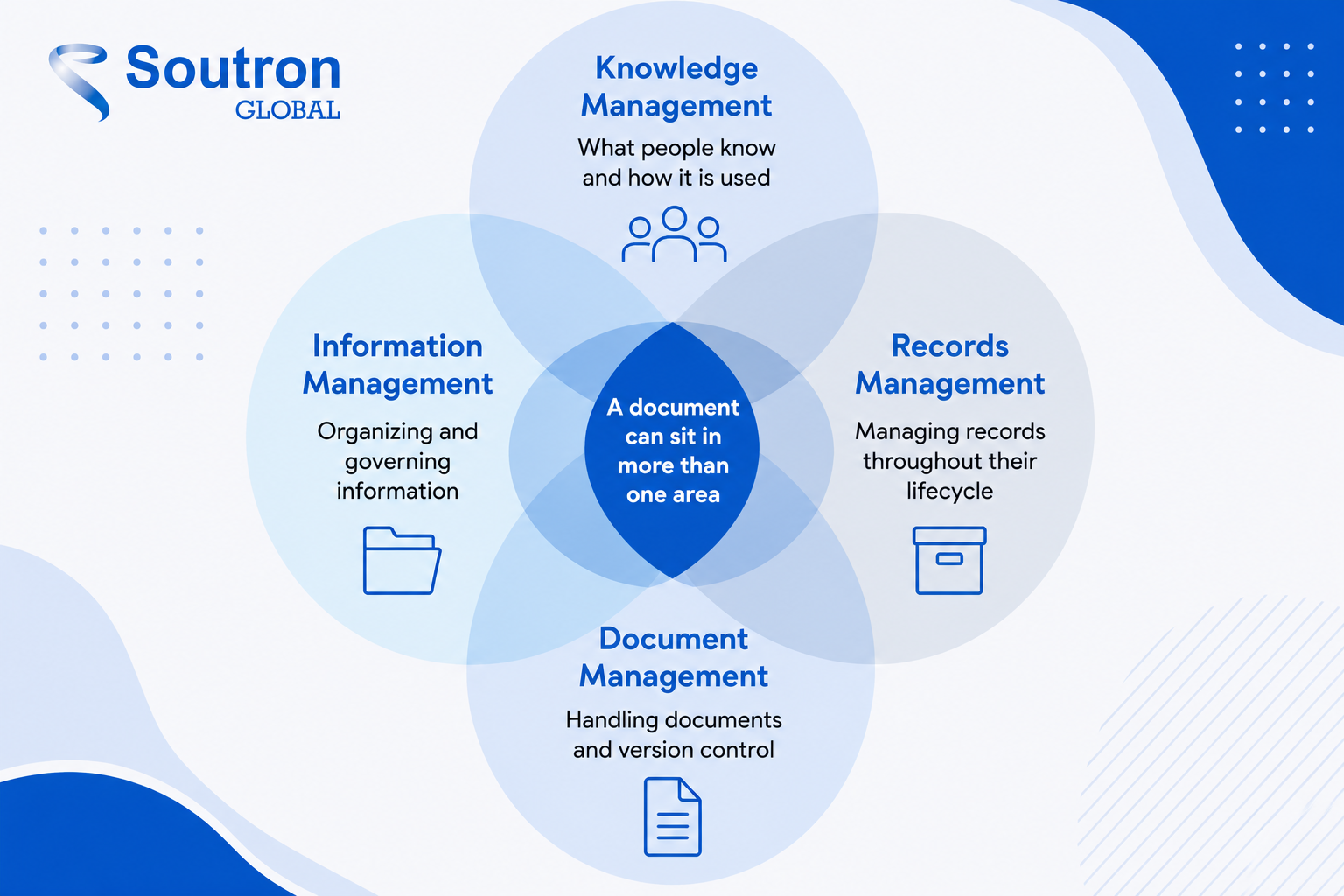
These terms overlap in practice, which is why they get used interchangeably. The same document can sit under more than one of them at the same time, and vendors tend to describe their software using whichever term is selling that year. The distinctions are still real, and they are worth holding onto, because each discipline answers a different question.
|
Discipline |
What it manages | What question it answers | Where it overlaps with knowledge management |
|---|---|---|---|
| Knowledge management | What people know, plus the recorded material that captures it | “What do we already know about this, and who knows it?” |
It is the reference point for the rows below |
|
Information management |
Information as an organizational asset: its collection, description, storage, and flow | “Where is the information we hold, and is it usable?” | The nearest neighbor and the most commonly confused pair. Information management does not address what is held only in people’s heads |
| Document management | Files: versions, check-in and check-out, storage, permissions | “Where is the current version of this document?” |
A document management system is usually a source that knowledge management draws from, not a replacement for it |
|
Records management |
Records that must be kept to meet a legal, regulatory, or business obligation, and disposed of when it ends | “What must we keep, for how long, and can we prove it?” | Driven by obligation rather than by reuse. One document can be both a record and a knowledge asset |
| Library or collection management (ILS) | A described collection of resources, whether purchased, licensed, or created in-house | “What do we hold, where is it, and who has it?” |
Supplies the description discipline, including cataloging, metadata, and authority control, that knowledge management depends on |
|
Knowledge base or help center |
A published set of articles answering known, recurring questions, usually for customers or support teams | “What is the approved answer to this question?” |
One output of knowledge management, frequently mistaken for the whole of it |
The sharpest line in that table is between records management and knowledge management, and it is a line of purpose rather than of content. A record exists because an obligation requires it: a regulation, a contract, a legal duty, or an internal policy reflecting one. ISO 15489-1:2016, the international standard for records management concepts and principles, frames the discipline around the creation, capture, and management of records rather than around their reuse.
Knowledge management starts from the other end: something is worth keeping because somebody will need it again. No rule obliges an organization to keep a good internal briefing on a market it exited, and it may be the most valuable document in the building on the day it goes back.
A completed project report can be a record under a seven-year retention schedule and a knowledge asset with no expiry date at all. The two frameworks do not compete. They answer different questions about the same file.
This is not a semantic exercise, because framing decides ownership. Scope a project as records management and it lands with compliance or information governance and gets measured on retention accuracy, which it can pass while nobody ever reads anything again. Scope the same project as knowledge management and it lands with a library, information, or knowledge team, gets measured on reuse, and fails quietly if the description work is skipped.
An integrated library system sits slightly apart from all of them. It manages a described collection of resources, and it is the discipline where controlled, contextual description is most mature. That is why this work so often ends up with people from a library or archive background. Where knowledge sits in collections, creating contextual descriptions are usually requires both information mangement expertise and an in-depth knowledge of what the organization does. It is time-consuming, which is why most organizations have a glut of unstructured knowledge assets that are difficult for an organization to take advantage of.
What does a knowledge management system actually do?
A knowledge management system is the software expression of the discipline, not the discipline itself. An organization can practice knowledge management with no dedicated system at all, and it can own an expensive KM system while practicing very little. Being clear about that before a procurement conversation prevents a good deal of disappointment afterward.
Setting product names aside, a system in this category has six jobs.
Capture and contribution: Knowledge gets in by one of three routes: staff submit it, it is ingested in bulk from systems that already hold it, or it is created in place. Which route matters less than whether contributing is easy enough that busy people bother. Where it feels like an administrative chore, the repository stays empty and the post-mortem blames the software.
Description: This is the part buyers underestimate most often and the part that decides whether anything else works. Content has to be described consistently enough to be retrieved by someone who does not already know it exists. That means metadata, a taxonomy or classification scheme reflecting how the organization actually thinks about its work, a thesaurus connecting the different words people use for the same concept, and authority control keeping names of people, organizations, and subjects consistent as records accumulate over years. Our guide to metadata management software covers how controlled vocabularies and taxonomy management work in practice. Without this layer, capture produces a store nobody can retrieve from, which is the commonest way one of these projects fails without anyone noticing.
Retrieval: Search across the repository is the baseline. Reaching content held elsewhere is where approaches diverge, and it is worth asking exactly how a given system does it. Enterprise search indexes external sources directly. Federated search queries them in real time through protocols such as Z39.50 and returns results from each. A third approach relies on shared taxonomies and metadata so that material in a document management system or intranet is described consistently enough to surface alongside everything else. Ask about unified search across connected information sources specifically and pin down its exact reach. Retrieval quality is a function of description quality, and a better search tool rarely fixes a findability problem on its own.
Access control: Configured roles and permissions determine who sees what. In regulated organizations and professional firms this is a functional requirement rather than an IT detail to settle later, because retrofitting a permissions model across a populated repository is slow and thankless work.
Review and currency: Content has to be checked, kept current, and retired when it stops being accurate. Out-of-date knowledge that is still findable is worse than knowledge that was never captured at all, because somebody will act on it in good faith.
Reporting: What is being found, what is being used, and what has never been opened once. The last is the most instructive of the three and the one worth confirming a system can actually produce before you sign anything.
A note on artificial intelligence: AI-assisted retrieval and summarization are standard in this category now, and they change the description question rather than removing it. A summary is only as dependable as the material behind it, and an assistant that cannot tell an approved current procedure from a superseded draft may present both as equally authoritative, potentially misleading users. We set out what that means for special libraries and archives in our discussion of knowledge management and artificial intelligence. For a buyer, AI features raise the value of the description layer rather than lowering it.
Which knowledge management methods do organizations actually use?
There is no standard sequence here, and anyone presenting one is describing a preference. What organizations do in practice is pick two or three approaches against a specific problem. The choice comes down to one question: is the knowledge in question easier to write down, or easier to pass from one person to another? Documentation suits the first. Conversation, mentoring, and shadowing suit the second. Treating everything as a documentation problem is the most common misstep. All five approaches below are attempts to produce the same behavior, knowledge sharing, and that behavior responds to incentives and management attention rather than to tooling.
Communities of practice group people around a shared area of expertise rather than around a reporting line. APQC, the research body that has studied this longest, treats them as a core approach. The test of one is whether it has a genuine shared problem and somebody with time to keep it alive. Assembled from an org chart, it becomes calendar clutter.
Lessons learned and after-action reviews capture what a project taught while the detail is still recoverable. Timing decides everything here. A review held within days of the event produces something usable; one held after the team has dispersed produces paperwork.
Expertise location makes it possible to find the person who already knows, which is frequently faster than finding the document. It earns its keep in organizations large enough that people genuinely do not know each other, and in a team of thirty it solves a problem nobody has.
Knowledge retention and transfer address the departure problem: succession, handovers, and retirements. A departure is the moment the cost of unmanaged knowledge becomes visible to people who were not previously interested in it, which is why departures so reliably prompt a wider program. Start months before somebody leaves, not during their notice period.
A knowledge audit establishes what the organization already holds, where it sits, and who depends on it. It is unglamorous and almost always the right first move, because nothing else reliably distinguishes a missing-content problem from a findability one.
On the SECI model. Ikujiro Nonaka and Hirotaka Takeuchi’s model of knowledge conversion, made up of socialization, externalization, combination, and internalization, is where much of this vocabulary originated, and it is worth knowing for that reason alone. It is a conceptual model of knowledge creation rather than an operating procedure, and treating it as a workflow is a dependable way to produce a program that reads well and changes nothing.
Are there standards for knowledge management?
Yes, and more than most buyers expect. The one written specifically for the discipline is rarely mentioned in vendor material at all.
|
Standard |
What it covers | Status | Why it matters to a buyer |
|---|---|---|---|
| ISO 30401:2018, Knowledge management systems: Requirements | Requirements for establishing, implementing, maintaining, reviewing, and improving a knowledge management system, meaning the management system rather than the software | Published November 2018. Amended 2022 and 2024. Under revision as ISO/DIS 30401 |
The only international standard written for this discipline. A serviceable checklist of what a credible program contains, even for organizations that will never certify |
|
ISO 9001:2015, clause 7.1.6, Organizational knowledge |
Requires a certified organization to determine, maintain, and make available the knowledge its processes need | Fifth edition, published September 2015. Sixth edition scheduled for publication on 16 September 2026 | Organizations already certified to ISO 9001 may find that knowledge management is an existing obligation rather than a new initiative |
| ISO 15489-1:2016, Records management: Concepts and principles | Concepts and principles for creating, capturing, and managing records | Second edition, April 2016, confirmed |
Marks where records obligations begin, so a project is not scoped as knowledge management when it is really a records requirement |
|
Description standards: Dublin Core, RDA, ISAD(G) |
How an individual resource is described so it can be identified and retrieved consistently | Current, maintained separately by their own bodies |
These sit underneath a knowledge management system. Native support for the ones an organization already uses is a practical procurement question |
The point most software marketing gets wrong about ISO 30401 is what it means by the word system. It uses the term in the management-system sense: policy, roles, planning, evaluation, improvement. It is not a specification for software. No vendor can sell you an ISO 30401 knowledge management system, because the standard describes what an organization does rather than what a product contains. Read that way it is useful even if you never intend to certify, and the revision now in development is worth tracking if you are building a program around it.
The ISO 9001 clause matters more immediately. If your organization is already certified, knowledge management is not a new initiative needing justification from nothing; it is an existing obligation you are probably meeting informally. That is often the strongest funding argument available, and it sits in a document the quality team already owns. Note that a sixth edition is scheduled for publication on 16 September 2026, so check the clause wording against whichever edition is in force when you write the case.
The description standards in the final row sit underneath the rest rather than alongside it, which is why native support for the ones you already use is a procurement question rather than a theoretical one.
Where knowledge management sits in different organizations
The function has no fixed home. Where it lands, and what it is asked to do, changes the work considerably.
Special libraries and corporate information centers: This is often where the function already lives, because the skills it needs are the skills these teams have. The knowledge is a mix of purchased research, subscriptions, internal reports, and staff expertise, across settings from corporate and special libraries to law, medical, news, and research information centers. Whether the team is called a library, an information service, or a knowledge center, the recurring problem is mandate rather than capability: a group treated as a cost center is asked to run the function for the whole organization with no authority to require anyone to contribute.
Law firms and in-house legal teams: Here the knowledge is precedents, drafted clauses, matter history, and knowing which partner has handled something similar before. The discipline has its own established vocabulary and its own software category, and we cover it separately in our guide to legal knowledge management.
Research and technical organizations: Consultancies, laboratories, and engineering and scientific bodies hold project history, test data, technical reports, and published research, spread across several systems organized by discipline rather than by the people searching them. Research organizations tend to share a characteristic failure: each specialism can find its own material and nobody can find anybody else’s.
Lucideon, a materials science consultancy working across healthcare, aerospace, nuclear, energy, and construction, had that shape of problem: international teams searching the World Ceramics Abstracts database, the library collections, and proprietary research papers as three separate exercises. Working with Soutron, it built a branded portal, the Lucideon Online Information Service, bringing those sources together with self-service requesting and usage reporting. The full Lucideon case study sets out how.
“Soutron has been a brilliant massive step forward for us and is now central to everything we do in the library.”
— Lucideon
Corporate archives and heritage organizations: These hold institutional memory formally, and their description practice is frequently the strongest anywhere in the organization. The question is not whether the material is well described. It is whether the archive is connected to the people who need it this quarter rather than only to researchers in fifty years.
Government and public bodies: Here the work usually arrives attached to a transparency, accountability, or continuity requirement rather than a productivity argument, which changes who sponsors it and what it is measured on.
How to choose a knowledge management system
Before comparing systems, establish what the organization needs to find and reuse, and who needs it. A knowledge audit, or a scoped pilot on one real and irritating problem, will tell you more than any vendor demonstration, because a demonstration shows what a product does well rather than what your organization does badly. Buy first and define requirements afterward and you get an expensive system configured around a process nobody agreed to, followed by a view that the system was the problem.
These are the questions worth taking into an evaluation, and what a weak answer sounds like.
|
Evaluation area |
Question to ask the vendor | What a weak answer sounds like |
|---|---|---|
| Description and metadata | Can we use our own taxonomy and metadata scheme, and which standards does the system support natively? |
“It is fully flexible,” with no standards named. Ask for the list. |
|
Authority control |
How does the system keep names, subjects, and terms consistent as content is added by different people over several years? | Free-text tagging offered as though it were the same thing. |
| Retrieval | Can users search content in the systems we already run, or only content we move into yours? By what method? |
A polished demonstration over sample data, with no discussion of connectors or scope. |
|
Access control |
Can permissions follow our real structure, including restrictions at the level of individual records or projects? | Permissions described only for whole collections or broad user groups. |
| Integration | Which of our existing systems does this connect to, by what method, and which of those connections are in production somewhere today? |
“We have an API” offered as the answer to every integration question. |
|
Migration |
What happens to our existing catalog, repository, or database, and who does the mapping work? | Migration treated as a data export problem rather than a description-mapping problem. |
| Review and currency | How does content get reviewed, approved, and retired, and who is accountable for it? |
An assumption that somebody on your team will handle it manually, forever. |
|
Adoption |
What does contributing look like for somebody who is not an information professional? | A power-user interface presented as the only interface. |
| Reporting | What can we see about what is being found, what is being used, and what never is? |
Login counts and page views offered as usage reporting. |
Mistakes worth avoiding
Buying a tool before agreeing on the problem: The most expensive mistake and the easiest to detect. If nobody can say in one sentence what will be findable afterward that is not findable now, the requirements are not ready.
Building a taxonomy in isolation: A classification scheme designed by two people in a room reflects how those two people think. Where it does not match how users understand the work, they fall back on free-text search and the taxonomy becomes decoration. Test it with the people who will search it before it is loaded.
Treating it as a project rather than a service: Projects close, and when they do, capture stops, review stops, and the repository decays at whatever rate the organization changes. Somebody has to own it afterward, with time actually allocated.
Measuring contribution instead of reuse: Ten thousand documents and no retrieval is a storage cost, not a knowledge asset. Count what gets found and used rather than what gets uploaded.
| You have the questions. The next thing you will be asked is what it is worth.
Most internal cases for a knowledge management system come apart on the value question rather than on requirements. Our guide to knowledge management ROI works through recovered time, avoided duplication, and the KPIs worth tracking, and it includes a calculator you can run without handing over your details. |
Where Soutron fits
Soutron builds information management systems for organizations whose knowledge sits inside collections, archives, records, and specialist libraries, with 50+ years behind that work. The connection to everything above is the description layer. The Soutron Information Management System is built around capture and tagging of organizational content, a multi-lingual thesaurus and authority control that keep description consistent as material accumulates, relational data structures, and configurable branded portals so that different audiences reach the same collection through an interface suited to them. It supports RDA, ISAD(G), ISAAR, and Dublin Core, along with legacy AACR2 records, integrates with SharePoint and iManage, and exchanges data through XML, MARC21, CSV, and provides a full API for integration with other systems. Access is governed by configured roles and permissions.
Where retrieval needs to reach past the repository itself, Soutron Discovery provides unified search across connected information sources, including library materials, subscriptions, and proprietary databases.
That suits organizations whose knowledge problem is fundamentally one of description and access across mixed collections. It is a weaker fit where the main requirement is a customer-facing help center, and it is worth saying so plainly rather than discovering it during an implementation.
Frequently asked questions
What are the five pillars of knowledge management?
There is no agreed set. Several five-part models circulate, most originating with individual consultancies rather than a standards body or professional association, and they disagree with one another. The components recurring across them are people, process, content, technology, and governance. For a structure with actual standing behind it, ISO 30401:2018 sets out requirements for a knowledge management system and is the closest thing to an agreed framework.
Is knowledge management the same as a knowledge base?
No, and the two are usually bought by different departments for different reasons. A knowledge base publishes approved answers outward, most often to customers, and support teams own it. Knowledge management serves internal specialists, includes material nobody has written down yet, and tends to sit with a library, information, or knowledge function. Conflating them is how organizations end up with help-center software and an unsolved internal findability problem.
How does a knowledge management system work?
Content is contributed by staff or ingested from systems that already hold it, described with metadata against a controlled vocabulary, made retrievable through search across the repository and connected sources, governed by configured roles and permissions, and reviewed on a cycle so it stays accurate. None of that sequence is automatic. Each step needs somebody accountable for it, which is why two systems with near-identical feature lists can produce very different results.
What is knowledge transfer, and how is it different from knowledge management?
Knowledge transfer is the movement of knowledge from one person or team to another, typically around a departure, a handover, or the close of a project. It is one activity within knowledge management rather than a synonym for it. The difference that matters operationally is direction: transfer moves knowledge to a known recipient, while knowledge management makes it available to people you cannot identify in advance.
Do you need a knowledge management system to practice knowledge management?
No. Many organizations start with practices rather than software: a lessons-learned routine after each project, a maintained directory of who knows what, a habit of reviewing key documents. A system becomes necessary when the volume of content, the number of contributors, or the need for consistent description and controlled access exceeds what shared drives and spreadsheets can hold reliably.
Is personal knowledge management the same thing?
No. Personal knowledge management is the practice of organizing your own notes, reading, and reference material for your own recall and thinking. It shares vocabulary with organizational knowledge management but not its purpose. Organizational knowledge management exists so that knowledge is usable by people other than whoever created it.
The part that actually decides it
Plenty about this work is genuinely difficult, culture and incentives and executive sponsorship among it, but storage is not the constraint. For organizations whose knowledge sits in collections, the constraint is description and reuse: deciding what needs to be findable, describing it consistently enough that somebody who did not create it can retrieve it, and keeping it current enough to be trusted when they do.
Organizations that get value from this work tend to move in the same order: establish what they hold, agree what needs to be findable and by whom, and only then decide what to buy. Where to start differs, though. An organization with an existing library, archive, or information team has a description capability to build on. One without has to acquire it somewhere, and that is a resourcing decision rather than a software decision.
If you are working out what that would look like across your own collections, we are happy to talk it through.