Records rarely arrive in an archive tidily. A closed matter transfers three years of case files, a completed project leaves behind a SharePoint folder, and a restructured department hands over boxes from offsite storage alongside a shared drive nobody has touched in years. Before any of it can be searched, cited, or relied on, someone has to formally take it in and establish what the archive now holds, and that first act is accessioning.
Accessioning is how an archive takes responsibility for new material, physical or born-digital, and the process documents enough about it to bring it under control. It is the point at which a transfer of records formally becomes part of the archive’s holdings rather than an undocumented set of boxes or an unmanaged folder on a server.
This guide explains what archival accessioning is in current practice, what it needs to establish for physical and born-digital records, how it works in a corporate archive, and how it relates to acquisition, appraisal, processing, and description.
| What is archival accessioning? Archival accessioning is the set of activities by which an archive takes formal responsibility for newly transferred or acquired records, physical or born-digital, and establishes enough control and documentation to steward them as part of its holdings. It is not one universal procedure; what it must establish stays constant, while how each archive does it varies with its policies, material, and systems. |
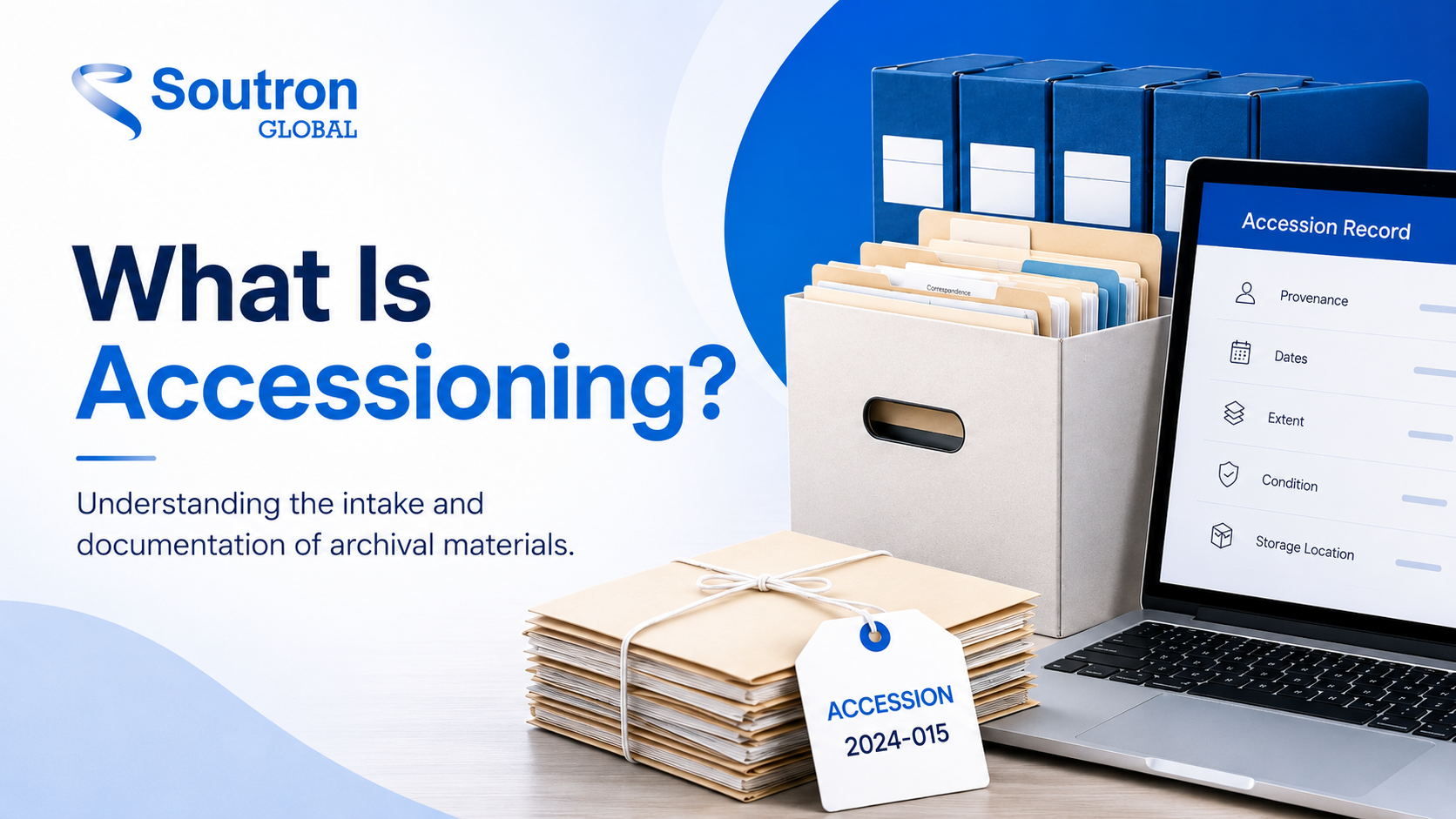
That framing reflects current professional practice. The Society of American Archivists defines accessioning as taking “legal and physical custody of a group of records” and formally documenting their receipt, and its accessioning best practices treat it as a suite of activities around transfer, appraisal, stabilization, and documentation rather than a single fixed step.
In museum work the same word refers to formally accepting individual objects into a permanent collection. Archival accessioning generally deals with groups of records and their context, custody, and control, which is the focus here.
Why early archival control matters
Good accessioning turns a transfer of material into records the organization can account for, protect, and rely on. Until material has been accessioned, the archive may hold it without a consistent record of its custody, provenance, extent, restrictions, and location, even when ownership has already passed. Without that record, the material cannot be reliably located, administered, or made available to the people who need it.
It also keeps material from disappearing into a backlog. Un-accessioned records sit in limbo, whether that is unlabeled boxes in offsite storage or an orphaned shared drive, undocumented and hard to find. Bringing everything to a basic, consistent baseline quickly, and setting priorities for later work, is what stops that from happening. For corporate and government archives this documentation also supports wider governance needs, though archival accessioning is distinct from the active records management that governs records earlier in their life.
What intake needs to establish
Because practice varies, it is more useful to think about what accessioning has to establish than to follow a fixed sequence. Whatever order an archive works in, a sound intake settles the following.
- Transfer and custody: Confirm the archive has the right to hold the material and on what terms, whether through a records schedule, a transfer agreement, a deposit, or a deed of gift.
- Provenance and context: Record who created or held the material, where it came from, and how it was used, so the records keep the meaning that context gives them.
- Rights, restrictions, and responsibilities: Capture access conditions, copyright, confidentiality, and any retention or disposal obligations attached to the material.
- Extent, formats, and technical characteristics: Quantify what has arrived, in boxes, files, items, or gigabytes, and identify formats across paper, audio-visual, and born-digital records.
- Integrity and preservation needs: Assess condition and flag what needs early attention: physical damage or fragility, and for digital material, at-risk formats and whether files have transferred intact.
- Baseline intellectual control: Create a minimal, consistent description so the material is known and accountable before any full processing.
- Location and access: Record where the material is held, physically or in which system, so it can be retrieved when access conditions allow.
How much an archive records against each of these, and in what order, depends on its policy, its material, and the archive management system it uses. The point is not to follow someone else’s checklist but to make sure none of these is missed.
What changes when an accession includes born-digital records?
Born-digital material may arrive on its own: as an email export, a SharePoint site, files from a cloud service, or storage media transferred by a department. The essentials are the same as for physical records, but a few things need particular care, and the U.S. National Archives guidance on electronic records treats digital transfers as a distinct activity with their own requirements.
- Preserve original context: Capture files with their folder structure, dates, and metadata intact, since that context is what makes them meaningful and is easily stripped by a careless copy.
- Document the transfer: Record how the material was transferred and what was received, using a manifest or inventory where the volume warrants it.
- Identify formats and verify integrity: Note the file formats, and generate checksums so you can verify fixity later and detect any unintended change. Where appropriate, scan for malware before the material joins the archive.
- Handle sensitivity: Sensitive information may be distributed across large volumes of digital files and may not be obvious from filenames or folder structures, so access restrictions and review requirements should be identified early.
From there, born-digital material should pass into a digital preservation workflow that guards against the risks specific to it, as formats fall out of support and storage media degrade, rather than sit unmanaged on an aging drive. How much of this an archive does at intake, and how much later, depends on its policy, its systems, and the risk attached to the material.
What information should be documented at intake?
The precise record structure varies by repository, policy, material type, and system. Some organizations keep a distinct accession record and register; others fold the same information into broader transfer, collection, or administrative records. A unique reference, often the year plus a running number, is common, but it is an administrative convenience rather than the point of accessioning. However it is stored, the information captured is usually along these lines:
|
Field |
What it records |
|---|---|
|
Reference or identifier |
A unique reference for the acquisition, where one is used |
|
Source |
Who, or which department, the material came from |
| Date received and date range |
When it arrived, and the period the records cover |
|
Description |
A brief summary of what the acquisition contains |
| Extent and formats |
The size and types of material, physical and digital |
|
Terms of transfer |
How it was acquired and under what agreement |
| Rights and restrictions |
Access, copyright, confidentiality, or retention conditions |
|
Condition and integrity |
Physical condition, and any digital risks or fixity checks |
| Location |
Where the material is held, physically or in which system |
How appraisal, acquisition, processing, and description relate
Accessioning sits alongside several other archival activities, and they do not run in a strict line. Appraisal may happen before, during, or after accessioning; archival description can begin at accessioning and continue for years. The table sets out how each relates, rather than implying a fixed conveyor belt.
|
Activity |
Main purpose | How it relates to accessioning |
|---|---|---|
| Acquisition | Obtaining material by transfer, deposit, donation, or purchase. |
Usually precedes accessioning and triggers it. |
|
Appraisal |
Deciding what has enough value to keep. | Can occur before, during, or after accessioning. |
| Accessioning | Taking formal responsibility and establishing basic control. |
The activity in focus here. |
|
Processing (arrangement and description) |
Organizing the records and describing them in depth. | Follows accessioning and builds on its record. |
| Archival description | Representing records so people can find and understand them. |
Begins at accessioning as a baseline and deepens later. |
The distinction that causes the most confusion is accessioning versus processing. Accessioning is the quick, essential intake that brings everything under basic control. Processing is the deeper work of arranging and describing records so people can use them, and it may happen months or years afterward. One makes sure nothing is lost; the other makes the material genuinely usable.
Accessioning in a corporate archive
In a corporate or government setting, accessioning is rarely a one-off event around a single donated collection. It is a recurring activity tied to how the organization creates and retires records.
- Recurring transfers and accruals: The same departments transfer records repeatedly, so a business archive needs to link new accruals to material it already holds rather than treating each as a fresh start.
- Records schedules and transfer policy: Transfers are often governed by a retention schedule or an internal policy rather than a deed of gift, which shapes what arrives and when.
- Corporate provenance: Provenance is organizational, tied to functions, departments, and events such as mergers or restructuring, and it shifts as the business changes.
- Business systems and confidentiality: Much of the material originates in enterprise systems and email, and a significant share carries commercial, legal, or personal sensitivity that has to be handled at intake.
This is also where archives and records management meet. The two are distinct disciplines, but in a corporate setting accessioning is often the handover point between them, which is why consistency and a clear record at intake matter so much.
Accessioning is where an archive’s rules become visible. What gets accepted, how it is recorded and who signs it off all follow from decisions made when the archive was set up. Our white paper on setting up a business archive works through those decisions in order.
Where archival descriptive standards fit
The description captured during accessioning may follow an established archival standard, a repository’s own schema, or a combination of the two. Soutron lists support for ISAD(G), ISAAR, and Dublin Core, alongside configurable record structures for archives that prefer their own approach. The full name of the ICA authority-record standard is ISAAR(CPF).
The wider landscape is also changing. The International Council on Archives now describes Records in Contexts (RiC) as its new standard for describing records, developed as the successor to its four earlier descriptive standards, including ISAD(G) and ISAAR(CPF). RiC places greater emphasis on the relationships between records, the people and activities behind them, and the contexts they belong to. Many archives still work to the established standards, so RiC is most useful to be aware of when planning for the long term.
What to look for in archival software at intake
Whatever system an archive uses, a few capabilities make accessioning easier to do consistently, especially once holdings and digital material grow. They are worth weighing before comparing products.
|
Requirement |
Why it matters |
|---|---|
|
Configurable intake |
Archives follow different policies and workflows, so fields and forms should adapt to yours. |
| Physical and born-digital together |
Hybrid transfers should stay connected in one record, not split across systems. |
|
Flexible description |
Metadata and standards requirements vary by repository, so the structure should flex. |
| Permissions and restrictions |
Sensitive corporate material needs access controlled from the point of intake. |
| Digital preservation path |
Born-digital records may need long-term preservation beyond descriptive control. |
These are the areas where a configurable system earns its place, and where the difference between a spreadsheet and a dedicated archive platform starts to show.
How software supports flexible archive workflows
Accessioning can be done on paper or in a spreadsheet, and in a small archive it often is. As holdings grow, and as more of what arrives is born-digital, that approach strains: records drift apart, fields get skipped, and physical and digital items end up tracked in different places. The right system is not one that imposes a fixed routine but one that adapts to how your archive already works.
Soutron Archive: control, description, and access
Soutron Archive is built around that flexibility. It supports the accessioning activities above with:
- Configurable fields and record templates you shape to your own workflow methodology, so intake is captured consistently whoever handles it.
- Physical and digital material in one record, describing paper, audio-visual, and born-digital items together, with full-text indexing.
- Custom deposit and enquiry forms with review tools, so staff and end users can submit material in a uniform way.
- Hierarchy, relational records, and authority control, so accruals link to existing holdings and terms stay consistent.
- Configured roles and permissions that restrict access to sensitive material, with the archivist in control through simple menu choices.
- Description to a recognized standard or your own structure, including ISAD(G), ISAAR, and Dublin Core.
MINISIS Trusted Digital Repository: long-term digital preservation solution
Digital preservation is a separate discipline, and Soutron handles it through a distinct, optional product. The MINISIS Trusted Digital Repository (TDR) can integrate with Soutron Archive to add the preservation layer that accessioning hands off for:
- Preservation ingest of born-digital material into a managed repository.
- Checksum validation and ongoing fixity checking to detect unexpected changes or corruption.
- Format and migration identification to keep material readable as formats age.
- Preservation metadata and archival information packages for long-term integrity and access.
Keeping the two matters clear : Soutron Archive establishes and maintains control, description, and access, while the MINISIS TDR provides a long-term digital preservation solution for the material that needs it. An archive can start with the first and add the second when preservation becomes a requirement.
| “Soutron’s archives platform and support services provided what we needed to digitize decades of documentation into a centralized database that increased Rochester IP findability,” states Turney. “I can’t say enough good things about Soutron, and highly recommend them.” Meghan Turney, MLIS, Archives Supervisor at Rochester Electronics, LLC |
| Bringing new archival material under control? See how Soutron Archive helps you accession, document, and safeguard physical and born-digital records on your own terms, with MINISIS TDR available where long-term digital preservation is part of the requirement. The first step is to learn more. Request a Demo |
Frequently asked questions
Is accessioning the same as digital ingest?
No. Digital ingest is the technical act of bringing digital files into a managed system, with checks such as format identification and fixity. Accessioning is the broader activity of taking formal responsibility for the material and establishing control over it. For born-digital records, ingest is often part of accessioning, but accessioning also covers custody, rights, context, and description.
Who should be involved in accessioning born-digital corporate records?
Usually more people than for paper. The archivist or records manager leads, but capturing born-digital material intact often needs input from IT or the system owner, from the department that created it, and, where the records are sensitive, from legal or compliance. Agreeing who does what before the transfer keeps context and integrity intact.
Can an accession contain both physical and born-digital records?
Yes, and increasingly it does. A single transfer might include boxes of paper alongside a set of digital files. A capable archive system records both in one accession, so the physical and digital parts of the same material stay connected rather than tracked separately.
Does every archive need an accession number or register?
No. A unique reference and a running register are common and useful, but they are not universal. Some archives fold the same information into broader transfer or administrative records. What matters is that custody, context, and control are documented consistently, not the specific form the record takes.
What is deaccessioning?
Deaccessioning is the formal, documented removal of material from an archive’s holdings. In a corporate setting it usually follows appraisal and a decision by whoever holds disposition authority, guided by retention policy and legal or business requirements. As with accessioning, the point is a clear record of what left, when, and on whose authority.
How should a corporate archive handle recurring transfers or accruals?
Treat them as additions to existing holdings rather than isolated events. Linking each accrual to the department and the material it belongs with, under a consistent record structure, keeps the archive coherent as the same sources transfer records over time. A system that supports hierarchy and relational records makes this far easier than a flat spreadsheet.
Conclusion
The measure of good accessioning is not whether it followed a numbered checklist but whether every transfer, physical or born-digital, leaves intake with a clear record of its custody, context, rights, extent, condition, and location, and with digital material set up for long-term care. When those elements are documented consistently, later processing, description, preservation, and access have a clearer foundation to build on. When they are not, every later stage inherits the gap.
The practical lesson is to keep accessioning consistent and to fit it to the way your archive actually works. Soutron Archive can be configured around your own structure and workflow, with the MINISIS TDR available where long-term digital preservation is part of the requirement.