What Is an Archive? Types, Uses and Examples
Ask two people what an archive is and you can easily get two unrelated answers. One will describe off-site storage of rarely used physical items. The other will point at the button in Gmail or Instagram that makes something disappear from view without deleting it. Both uses are ordinary, and the overlap in terminology causes genuine confusion inside organizations that are trying to work out what they hold where, and who should be responsible for it.
An archive is a collection of materials kept permanently because of their continuing value as evidence of what a person or organization did. The items (books, product samples, business records) are usually unique, created in the course of ordinary activity rather than made to be historical. |
What is an archive?
The Society of American Archivists’ Dictionary of Archives Terminology records several distinct senses in professional use, while noting that archivists generally recognize: the catalog record, the database or facility where they are stored, and the organization responsible for both. Someone can accurately say they work in an archive, work for an archive, and spend the afternoon reading an archive, and mean something different each time.
What holds those senses together is the idea of continuing value. A record has continuing value when it is still worth keeping after it has stopped being useful for the work that produced it. A book and the items used to promote it matter to the publications team when the book is released. Decades later the archive materials held matter for a different reason, because it proves when it was published for anniversary editions, book jackets approved, language versions, copyrights, and what markets it was published in.
The other defining quality is that archival material is a collection of related items. The International Council on Archives defines archives as “the documentary by-product of human activity retained for their long-term value,” consisting of letters, photographs, emails, or recorded meeting minutes that are referred to decades later for legal clarification. Being a by-product does not make a record automatically trustworthy, and archivists do not treat it that way. ICA sets out four qualities that decide whether a record can be relied on: authenticity, reliability, integrity and usability. What the by-product quality gives a record is evidential context, and that context is much of how those four are established later.
Organizations have been keeping records this way for as long as they have needed authoritative proof, and the practice long predates any of the institutions we now think of as archives. The history of archives is a subject in its own right.
What makes a record archival?
Age is the wrong test, and it is the one most people reach for first. A box of forty-year-old duplicate invoices is not archival. A folder of emails from last spring documenting how a merger was approved may well warrant permanent retention. Four questions get you closer than the calendar does.
Does it still prove something relevant? Continuing value takes several forms: evidence of what an organization did and why, information about people, places or subjects that outlasts the original purpose, and legal weight that has not expired. If none of those apply, the record belongs in a retention schedule and eventually a disposal decision or perhaps selected for digital preservation.
Is it replaceable? This question separates archives from almost everything else. A library can order in a fresh copy of a damaged title. Archival records are typically unique, or irreplaceable in their evidential context: a signed agreement, an annotated design drawing or an internal memo exists in that form once, and a photocopy or scan of it is not the same evidence. Archives do hold duplicates and digital surrogates, but the original carries the weight.
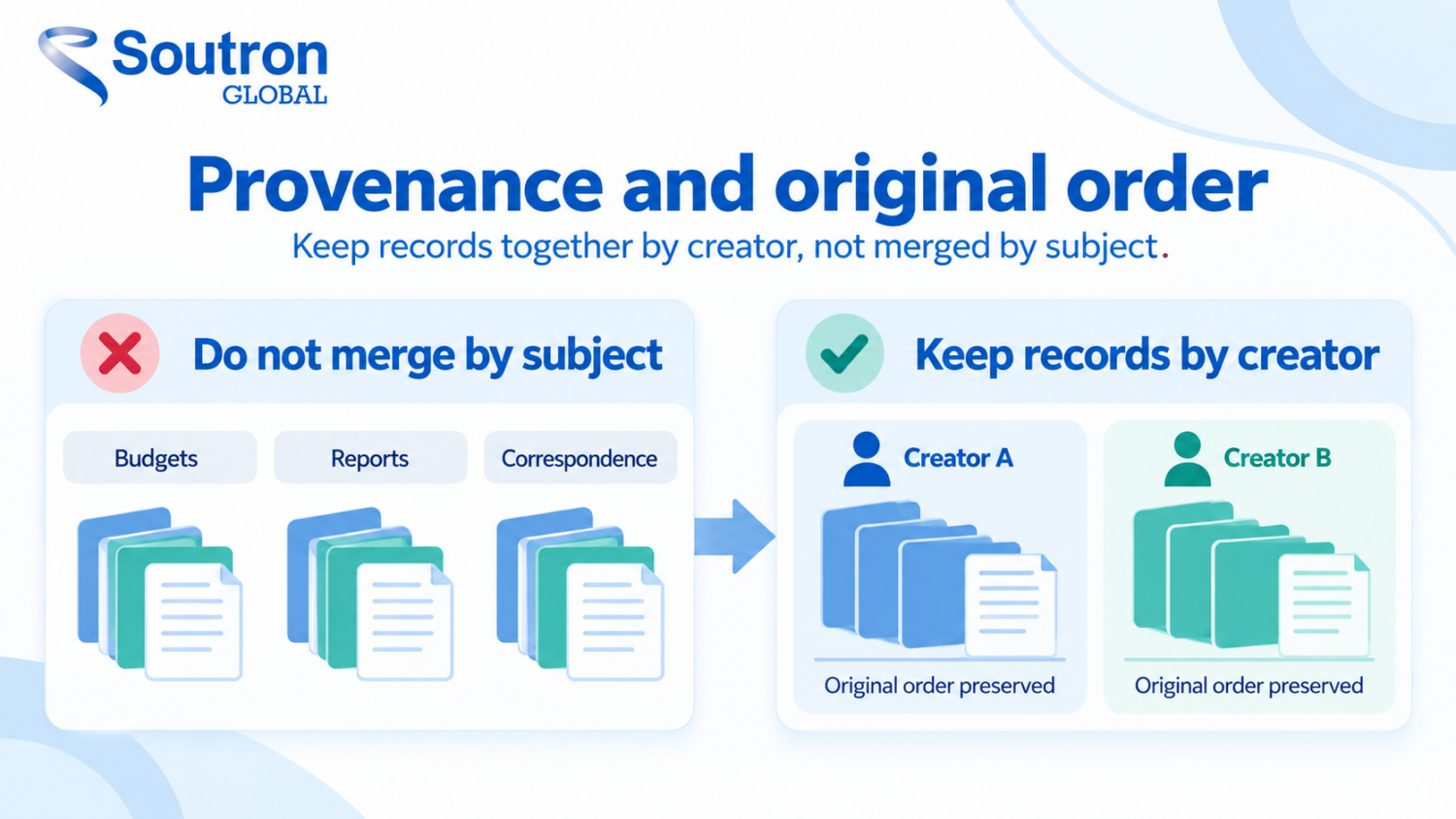
Do you know who created it? Archives are grouped by the person, family, department or organization that produced them, a principle archivists call provenance. Records from two creators are not merged even when they cover the same subject, because who produced a record is part of what it proves. The full body of material from one creator is called a fonds.
Does the original arrangement still tell you anything? Where the creator’s own filing order survives and carries meaning, archivists keep it rather than reorganizing by topic, because how somebody chose to file their papers is evidence of how they worked. Where that order was lost or never meant anything, an archivist imposes a workable arrangement and says so in the description.
Those last two principles are why searching an archive works differently from searching a library catalog. Archival description is hierarchical and starts with contextual description: a collection and its structure are described first, and individual items are reached only where the material warrants that level of detail. The software category built around that hierarchy is the archive management system.
What are the main types of archives?
Archives are usually classified by who owns them and why, and the differences are practical rather than academic. What sits on the shelves varies enormously.
Government archives are the ones most people picture. The National Archives and Records Administration holds the federal record of the United States. Below that, arrangements vary: states generally maintain their own archives, while counties and municipalities may run a records repository, appoint a records officer, or transfer permanent material to a designated archival institution, such as a historical society. Typical holdings include census returns, naturalization files, military service records, land grants, building blueprints, court papers and homestead applications. Records of this kind are the backbone of most citizenship, land grants, and genealogical research.
Academic and university archives keep two distinct things side by side. The first is the institution’s own record: trustee minutes, presidential papers, building plans, course catalogs, student newspapers and commencement programs. The second is special collections, meaning donated papers and rare material acquired to support teaching and research rather than produced by the university itself.
Business and corporate archives exist for reasons that are usually commercial rather than sentimental. They hold founding and incorporation documents, board minutes, original product designs and prototypes, packaging and advertising history, brand assets and correspondence documenting major decisions. Companies keep them because the material does work: evidence in disputes over ownership, rights or prior use, source material for anniversary and heritage marketing, a reference point for product development, and a record of how the organization came to look and operate the way it does. Manufacturers, pharmaceutical companies and long-established consumer brands tend to have the most of it. Whether a company manages that material as an archive usually comes down to one thing: the value the company assigns to the items. Business archive collections without an owner tend to become undescribed storage.
Nonprofit and association archives document program delivery, grant history, campaign material, building blueprints, membership records and photographs. Material of this kind is often unavailable anywhere else, which makes it valuable to researchers and vulnerable when an organization restructures.
Religious archives hold registers of baptisms, marriages and burials, parish and congregational records, land grants, sermons, correspondence, and ceremonial objects. In many countries these registers predate civil registration by centuries and are among the most important surviving population sources for the period. In the United States, for example, some of the early colonial land grant records were held by religious organizations. Maryland, for instance, was funded by the Jesuits, while Virginia relied on the Church of England. Records of land grants issued in the 1600s are used today to establish ownership boundaries.
Film and media archives preserve footage, production files, scripts, continuity notes, stills and set documentation. The technical problems here are unusually stubborn, because the carriers degrade and the playback equipment becomes unobtainable.
Personal and family archives are the ones least likely to survive: letters, diaries, photographs, deeds, certificates and, increasingly, phones, laptops and cloud accounts. A house clearance is where a great deal of this material is either lost or boxed up and donated to a historical society.
How is an archive different from a library or a records management program?
The library comparison is the one people ask about most, and the honest answer is that the two professions share a purpose and diverge on method. Both collect material, look after it and make it available for research. Where they part company, as the Society of American Archivists sets out in its account of the profession, is replaceability. A library can order in a fresh copy of a damaged or missing title. Archival records are typically unique, or irreplaceable in their evidential context, and that constraint drives every difference in how the material is arranged, described and handled.
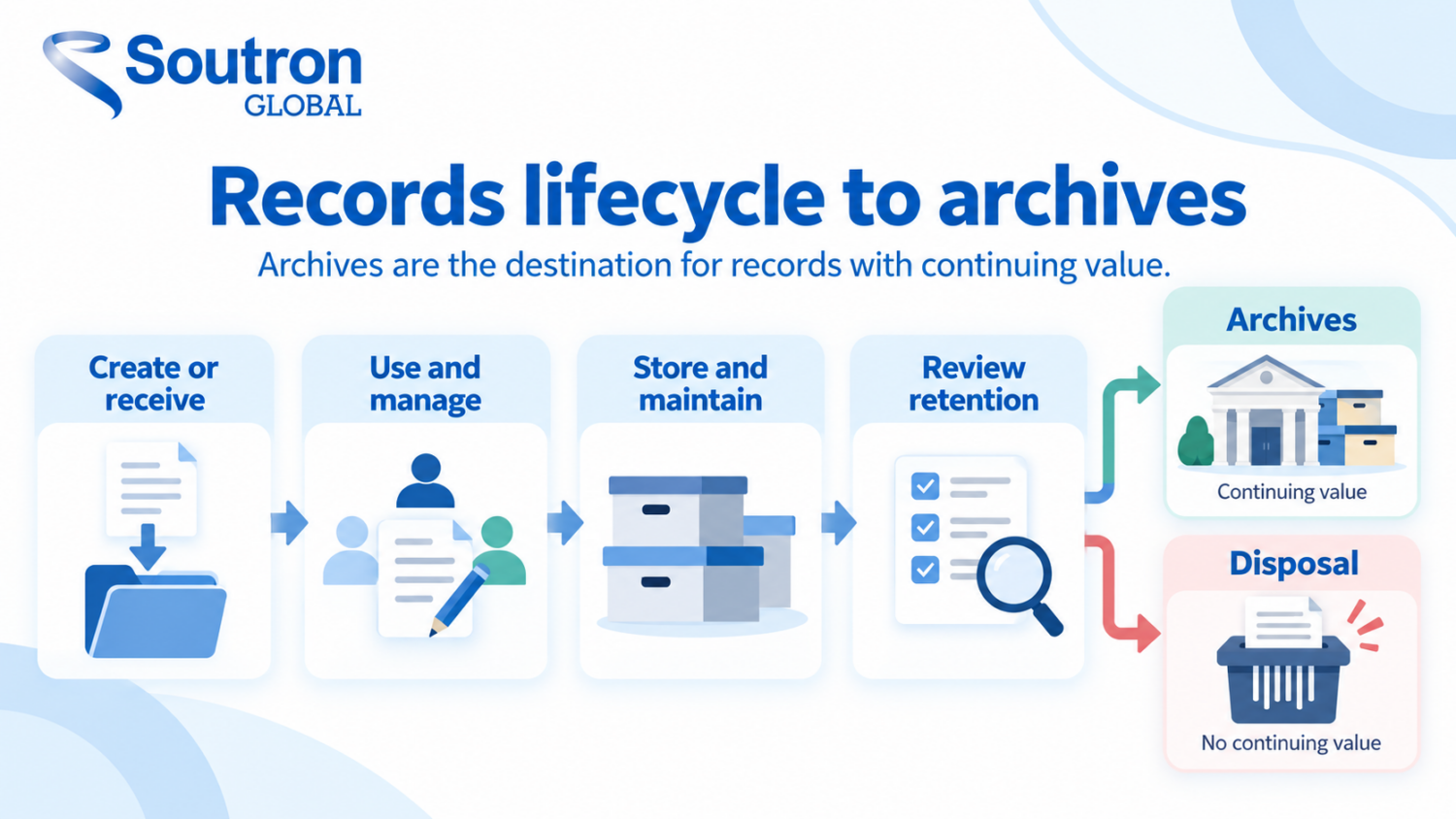
The records management relationship is more commonly misunderstood, and it matters more operationally. Records management and archives are not competing systems. They are two ends of one lifecycle. Records management governs a record from creation through classification, retention and eventual disposition. Archives are what survives that disposition decision, kept because it has continuing value. A retention schedule that has no destination for permanent records is an incomplete schedule. Some organizations solve that with an internal archive, some deposit material with an external repository, and some have simply never decided, which is where records quietly accumulate with no owner.
Archive | Library | Records management | Museum collection | |
|---|---|---|---|---|
What it holds | Records created through activity, typically unique and unpublished | Published works, usually held by many institutions | The organization’s records across their full lifecycle | Objects and artifacts, often three-dimensional |
Can it be replaced | Usually not | Usually yes | Depends on retention status | Usually not |
How it is arranged | By creator, in original order where meaningful | By subject classification | By record class and retention schedule | By accession and collection |
How you find things | Finding aids and collection-level description | Catalog, described item by item | Classification scheme and index | Object catalog and accession register |
Who uses it | Researchers, legal and compliance teams, the parent organization | General and specialist readers | Staff, auditors, legal teams | Curators, researchers, the public |
Main purpose | Evidence and long-term institutional memory | Access to published knowledge | Compliance, retrieval and defensible disposal | Interpretation, display and study |
Is the archive button in Gmail or Instagram the same thing?
Software uses the word much more narrowly. Archiving a message in Gmail or Outlook, a post on Instagram or an order on Amazon moves it out of your active view without deleting it. That is decluttering, and it involves no appraisal, no description, no preservation planning and no guarantee of future access.
The distinction worth holding onto is that an archive is not a backup. A backup exists so that you can restore yesterday’s version of something you already understand. An archive exists so that somebody who was not there can find a record in thirty years, understand what it is, and rely on it. That takes description and context above all. For digital records it also takes integrity controls, such as checking that a file still matches the state it arrived in, and a plan for what happens when its format stops being readable. A drive full of undescribed files is not an archive, however carefully it is duplicated.
What does an archivist do?
The role covers five areas of work. They are not a fixed sequence, and in practice they overlap and repeat across the life of a collection.
- Appraisal: Deciding what has continuing value and what does not, a decision that is close to permanent in both directions.
- Acquisition and accessioning: Recording what arrived, in what condition and from whom. Legal title is a separate matter, settled by a deed of gift, a transfer agreement or a deposit arrangement, and some material is held without title passing at all. Archival accessioning is the point at which a pile of material becomes a documented holding.
- Arrangement and description: Establishing the structure of a collection and producing the description that lets someone find things in it.
- Preservation: Controlling the physical and digital conditions that determine how long material survives, including acid-free housing, stable temperature and humidity, in addition to using a digital preservation solution for digital materials.
- Access: Running the reference service, managing restrictions, and publishing descriptions so people outside the archive know the material exists.
The profession is small. The US Bureau of Labor Statistics Occupational Outlook Handbook puts employment at roughly 10,300 archivists across the United States, and typical entry is at master’s level, most often in history, library science, archival studies, political science or public administration. If your organization is weighing whether to appoint someone, share the role, or bring in an external specialist for a defined piece of work, that is the labor market you are hiring into.
What standards do archives use to describe collections?
Several standards are in play at once and they do different jobs, which is where most confusion about this starts.
Content standards govern what a description should say. In the United States that is Describing Archives: A Content Standard (DACS), which the Society of American Archivists positions as the US implementation of the international standards ISAD(G) and ISAAR(CPF).
Encoding standards govern how a finding aid is structured so it can move between systems. Encoded Archival Description (EAD) reached version 4.0 in July 2026. Dublin Core sits alongside these as a general metadata schema, used most often for digital objects rather than for archival description itself.
Underneath all of it the ground is shifting. The International Council on Archives has published Records in Contexts, whose conceptual model reached version 1.0 in December 2023 and which ICA says reconciles, integrates, builds on and replaces its four earlier descriptive standards. Adoption is in progress rather than complete, and the application guidelines are still at an early version, so organizations may encounter both legacy descriptions and RiC-based approaches during the transition.
How do you know if your organization already has an archive?
Archival material does not always sit in something anyone calls an archive. It can be a storage room, a locked cabinet, a shared drive nobody has permission to tidy, or a set of boxes that came back from a former employee’s office and were never opened. The label tends to arrive long after the material does.
Material that regularly turns out to be archival includes:
- Founding and incorporation documents, board and trustee minutes
- Original product designs, patents, prototypes, packaging and brand assets
- Correspondence and photographs documenting decisions, sites, buildings or people
- Agreements, licenses and leases that continue to have legal effect
- Records of buildings, land or sites the organization holds or once held
- Anything an employee kept because they thought somebody would want it one day
If several of those are sitting somewhere without a description, you have an archive. Whether it is being managed is a separate question.
Physical risk is real: fire, water, mold, pests, poor storage conditions and rough handling all destroy material, and none of that goes away because a collection is indoors. The quieter risk is the loss of intellectual control. Deliberate destruction is rarely what removes a collection. It disappears when the one person who knew what was in the boxes retires and nothing they knew was written down, at which point the holding becomes indistinguishable from clutter and is treated accordingly during the next office move.
What changes that is description: a record of what you hold, structured from collection level down, that staff and authorized users can search and understand without relying on one person’s memory.
Working out what you already holdDescribing a collection properly means recording its structure as well as its contents. Soutron’s archive management solutions are built for that: hierarchical description running from fonds through series, sub-series, file and item level, cataloging with configurable fields and record templates, thesaurus and controlled terms with metadata relationships, and a customizable search portal that works on desktop, tablet and mobile. If you are weighing options, you can compare archive management software side by side before you shortlist. |
What happens to records that were born digital?
Much of what now enters archives was never on paper and never will be. That changes the risk profile rather than the principles.
Paper fails slowly and visibly. Digital records fail differently: a file becomes unreadable when its format falls out of support, when the software that wrote it no longer exists, or when the storage media degrades, and unlike paper it can be altered without leaving any visible trace. The archival response has three parts. Record a checksum when the file arrives and re-verify it periodically, so that any change can be detected rather than assumed away. Track the file formats you hold and plan for the ones heading toward obsolescence, rather than trusting that they will still open. Capture the technical and contextual metadata at the point of transfer, while the person who can explain where the file came from is still available to ask. A trusted digital repository is needed to protect born digital materials from format obsolescence.
The practical implications are covered in more depth in our guide to digital archiving.
Frequently asked questions
Is “archives” singular or plural?
Both are correct, which is why professional usage looks odd at first. Archivists frequently write “an archives” when referring to an institution, following the convention used by bodies such as the National Archives. “An archive” is the more common form in general writing and is not wrong. Neither will confuse a specialist.
What is the purpose of an archive?
Three things, in practice. It provides evidence, so that decisions, rights and obligations can be checked against an original record rather than a recollection. It supports accountability, particularly where public money or regulated activity is involved. It preserves institutional memory, so that an organization can still explain why it works the way it does once the people who decided are gone.
Who decides which records are kept permanently?
In most organizations it is a shared decision rather than one person’s call. The archivist or records manager appraises the material against a retention schedule, and legal, compliance or the department that created the records is usually consulted where obligations or sensitivities apply. In public bodies the retention rules themselves may be set externally by statute or by a national or state archives.
What is an example of an archive?
They exist at very different scales. The National Archives and Records Administration holds the federal record of the United States, including the Declaration of Independence. A university archive holds its founding papers, faculty collections and student publications. A manufacturer’s archive might hold nothing but seventy years of product drawings and packaging.
Do you need permission to use an archive?
Requirements vary by repository and by collection, and most of what you meet is procedural rather than a permission decision: registering as a reader, requesting material in advance because it sits in closed stacks or off-site storage, and consulting it in a supervised reading room. Genuine restrictions do exist, usually relating to data protection, donor conditions or commercial sensitivity.
The short version
An archive is defined by the continuing value and the context of what is inside it, not by how old the material is or what kind of room it sits in. That is why a shared drive created last year can be genuinely archival while a box of century-old paper turns out to be worth nothing, and why the arrangement matters as much as the documents.
If you suspect your organization holds material of this kind, the first useful step is not conservation. It is a description. Nothing can be protected, retrieved or valued until somebody can authoritatively say what it is and where it came from.