Enterprise Metadata Management Software
Introduction
In 2026 organisations face unprecedented challenges in managing the ever-growing volume and complexity of data assets. This page provides a comprehensive overview of metadata management software what it is, why it matters and how to choose the right solution for your needs. Whether you are a librarian, archivist, knowledge manager or part of an IT or data team, understanding metadata management and AI-enabled metadata generation, is essential for ensuring data quality, compliance and operational efficiency. This guide is designed to help you navigate the evolving landscape of metadata management software, highlighting its importance for digital transformation, regulatory compliance and AI-driven discovery.
What Is Metadata Management Software?
Organisations increasingly rely on metadata management tools to improve data discovery and enhance data quality. Manual approaches to tracking metadata no longer work due to the explosion of data sources, formats and users, driving the need for AI-enabled metadata tools. Effective metadata management helps organisations achieve regulatory compliance and support data initiatives. Modern metadata management tools help organisations collect organise, govern and utilise metadata across their data stack, improving data quality, compliance and operational efficiency.
Metadata is data about data. It provides context, content and structure to data assets, enabling organisations to make informed decisions. There are three primary types of metadata:
- Descriptive metadata: Information that describes the content of a resource, such as title, author, abstract and keywords.
- Administrative metadata: Details that help manage a resource, including creation date, file type, access rights and ownership.
- Technical metadata: Information about the technical aspects of a resource, such as file format, size and data lineage.
A robust metadata management tool should offer features such as data lineage tracking, access control and efficient data search capabilities. These features ensure that metadata provides the necessary context for data assets, supporting data governance, compliance and discovery.
Metadata management software is a specialised system designed to capture, structure, enrich and govern descriptive, administrative and technical metadata for both physical and digital resources. For cultural institutions, this means handling standards like Dublin Core for basic resource description, bibliographic data and archival frameworks such as ISAD(G) and DACS alongside subject headings, taxonomies and authority files that conform to specific metadata schemas such as the IPTC Metadata Standard, which governs digital image metadata and is maintained by the International Press Telecommunications Council (IPTC).
Modern data teams focus on data democratisation, collaboration and the use of specialised tools to make data more accessible and understandable for analysts, engineers and business users. These teams rely on advanced metadata management software to ensure that information is easily discoverable and usable across the organisation.
A centralised platform connects cataloguing workflows with discovery interfaces and preservation systems, automating ingestion from PDFs, repositories and legacy databases while enforcing standardisation through controlled vocabularies. Automated metadata harvesting connects directly to databases, data lakes and ETL systems to automatically extract metadata, reducing manual effort and accelerating data discovery by pulling information from warehouses, lakes and BI tools. Automated metadata management reduces maintenance overhead and improves accuracy as data environments scale.
Key Takeaways
- Modern metadata management software captures, structures and governs descriptive, administrative and technical metadata for physical and digital resources, forming the foundation for enterprise search, information governance, AI applications and digital preservation in 2026.
- Soutron Global provides scalable metadata management tools integrated within their SaaS-based platforms that are specifically tailored to special libraries, archives, museums and knowledge hubs not generic enterprise data teams focused on analytics dashboards.
- Soutron’s special archives and library solution provides AI-assisted metadata extraction (shipping spring 2026) that transforms PDF cataloguing from manual record creation to expert-level curation, with a “human in the loop” reviewing and approving AI-generated metadata cataloguing drafts directly from within their existing cataloguing workflows.
- Key benefits include automated metadata discovery, faster cataloguing workflows, richer records with abstracts and keywords, improved data discovery for researchers and human-in-the-loop quality control that prevents errors.
- Organisations can request a Soutron demo to see AI metadata management in action and explore how it addresses their cataloguing backlogs.
Why Active Metadata Management Matters in 2026
Use cases span special archive collections, corporate knowledge hubs, legal libraries and research repositories where trusted data depends on consistent description. Unlike generic data catalogues built for enterprise analytics tools and BI dashboards, metadata management tools for cultural sectors emphasize cataloguing, discovery and digital preservation of information assets rather than data pipelines for business intelligence.
The importance of metadata has grown as more companies invest in AI and data-driven decision making.

Why Metadata Management Matters in 2026
Since 2020, rising volumes of PDFs, born-digital records and digitised collections has resulted in a backlog of items to be manually catalogued, making the process unsustainable at existing staff levels. Global digital collections in archives and museums has reportedly grown by over 50% annually post-pandemic, creating backlogs that traditional workflows cannot address.
Machine-readable, consistent metadata is what allows language models, discovery portals and knowledge hubs to return relevant results. Research indicates that 95% of AI projects fail due to poor metadata context rather than model limitations making data quality foundational for AI outcomes.
Governance pressures in sectors Soutron serves legal, government, engineering firms, professional research institutes require accurate, auditable records for regulatory compliance. This demands understanding data provenance, ownership and sensitive data tracking.
The shift from static catalogues toward active metadata management means metadata continuously supports data discovery, analytics and workflow automation. It is predicted that in 2026, metadata management will become mission-critical infrastructure for decision making and data driven decision making across organisations.
To address these challenges, modern metadata management tools offer a range of capabilities, as described below.
Core Capabilities of Modern Metadata Management Tools and Software
Modern metadata management tools deliver several integrated capabilities that transform how institutions handle their data assets and collections.
Discovery and Ingestion
Enables automated harvesting of metadata from PDFs, websites, repositories and legacy systems. For example, batch-importing research reports can extract titles, authors and abstracts via OCR, dramatically reducing manual effort.
Standardisation and Normalisation
Maps data to standards like MARC or Dublin Core while applying thesauri such as the Getty Art & Architecture Thesaurus. This ensures data integrity across diverse data sources.
Taxonomy and Thesaurus Management
Handles subject headings, corporate taxonomies and multilingual vocabularies that power faceted search and browsing. Proper governance of these vocabularies directly improves data literacy among users.
Workflow and Approvals
Provides configurable review, approval and quality assessment steps. This keeps librarians, archivists and collection managers in control of catalogue integrity while supporting data governance teams.
Search and Discovery
Delivers end-user portals with faceted search and filters that leverage rich metadata. Business users and researchers find the right item quickly through self service analytics capabilities.
Integration and Interoperability
Through APIs synchronises metadata with discovery layers, digital preservation systems and enterprise content management tools connecting your entire data ecosystem.
Analytics and Reporting
Feeds usage data, search logs and cataloguing statistics back into metadata improvement and collection development, generating metadata insights that inform better decisions.
With these capabilities organisations can streamline metadata workflows and enhance the value of their data assets. Next, we’ll explore Soutron’s unique approach to metadata management.
Soutron’s Approach to Metadata Management
Soutron’s Metadata tools underpin multiple Soutron products: the integrated library system (ILS), archive management, museum and cultural asset management and knowledge hubs. The platform emphasizes configurability custom fields, local cataloguing rules and department-specific schemas reflect each institution’s collections and workflows.
Integrated thesaurus and taxonomy management supports subject headings, corporate vocabularies, business glossaries and authority control. These feed directly into discovery interfaces, helping data practitioners and non technical users alike.
Soutron supports physical items (books, archival boxes) and digital ones (PDFs, images, AV files) under a single metadata framework. The cloud-based architecture provides secure, browser-based data access for distributed teams across offices, branches or countries.
A key differentiator: Soutron focuses on cataloguing , discovery and digital preservation of information assets rather than analytics datasets. This domain expertise serves organisations where context and business context around collections matter more than data flows for dashboards.

AI-Assisted Metadata Extraction: Transforming Manual Cataloguing
In an era where digital content is expanding at an unprecedented pace organisations across sectors corporations, archives, libraries, museums and government institutions are facing a critical challenge: how to create, manage and maintain high‑quality metadata at scale. Traditional metadata management software has long supported the organisation and retrieval of valuable information assets, but manual workflows and static systems no longer keep pace with today’s demands.
Why Metadata Management Software Needs to Evolve
Metadata sits at the centre of how users discover, analyse and understand information. Traditional spreadsheet-based tracking methods are prone to errors, duplication and scalability issues. Creating accurate, rich metadata has historically required:
- Manual data entry
- Time‑intensive copy cataloguing
- Staff with specialised knowledge
- Inconsistent or incomplete taxonomies
- Limited scalability
As digital collections multiply and users expect fast, intuitive access to information, metadata workflows must become smarter, faster and more reliable. The next generation of metadata management software must support automation, expert oversight, custom taxonomies and scalable processing all while maintaining record integrity and organisational control.
To meet the evolving need for richer metadata and faster cataloguing workflows, in April 2026, Soutron Global announced a transformational enhancement: AI-assisted metadata extraction and catalogue record creation for PDFs within the Soutron platform.
Soutron Metadata Management Software: Built for Flexibility, Control and Discovery
This new, transformational metadata workflow operates step-by-step:
Step 1: Select PDFs
A cataloguer identifies and selects a single PDF or even hundreds of PDFs for inclusion into the archive or library catalogue.
Step 2: Connect to AI
Soutron securely connects to Anthropic (Claude), Google (Gemini) or OpenAI (ChatGPT).
Step 3: AI Extracts Metadata
The AI extracts metadata and proposes a draft record in real-time.
Step 4: Review and Approve
The cataloguer reviews, validates and approves the metadata before automatic ingestion for a single catalogue record or hundreds of catalogue records which are uploaded to the database via FTP.
Key fields the AI populates include abstract/summary, author names, title, ISBN (where present), number of pages and copyright statements in addition to specific business unit or company metadata custom fields. This changes cataloguing from record creation to expert-level curation where professionals refine AI-suggested metadata.
The built-in “human in the loop” review process ensures archivists and librarians validate or edit fields before automated ingestion. This prevents decision-making hallucinations while benefiting from machine learning speed.
Custom Taxonomy Metadata Field Mapping
Custom taxonomy metadata mapping allows AI-extracted concepts to align with institutional vocabularies and custom fields. The feature enables cataloguing at scale bulk import, review and approval of multiple records ideal for backlogs of reports or research collections.
“When a cataloguer identifies a PDF for inclusion into their Soutron catalogue, the new workflow uses a connected, secure, OpenAI instance or your company’s LLM of choice to extract the metadata,” states Graham Partridge, Vice President of Products at Soutron Global.
Deployment timing: AI metadata extraction for PDF documents ships in the spring 2026 release and will be available automatically to clients on current support or subscription agreements.
Benefits of AI-Powered Metadata Management for Libraries and Archives
AI-powered metadata discovery reduces bottlenecks, enriches records and improves end-user discovery across Soutron-powered collections. Here’s what organisations gain:
- Time Savings and Efficiency: Reducing the need to create or copy catalogue records from scratch shortens cataloguing cycles significantly. What previously took days can now take hours.
- Richer, More Consistent Metadata: AI surfaces abstracts, keywords and contextual details that help researchers quickly assess relevance. Human review ensures data quality while data continues to flow efficiently.
- Improved Discovery and Decision-Making: Richer records support precise search filters, better recommendations and faster answers. This delivers business value through improved support for evidence-based decision-making.
- Scalability for Digital Backlogs: Processing thousands of PDF reports, technical standards or policy documents that were previously under-described becomes achievable without additional headcount.
- Governance and Quality Control: Human-in-the-loop validation protects against errors while documentation remains auditable for data governance and data security requirements.
- Flexibility of AI Models: Organisations can choose from Anthropic (Claude), Google (Gemini) or OpenAI (ChatGPT)
“Empowering information professionals with time-saving intelligent automated processes that eliminate cataloguing bottlenecks and expand our clients’ service delivery demonstrates the value that Soutron delivers,” states Brad Frasher, CEO of Soutron Global.
With these benefits organisations can transform their metadata management approach and unlock new efficiencies. Next, we’ll see how metadata management software supports broader data governance and information management functions.
How Metadata Management Software Supports Data Governance and Key Information Management Functions
Metadata management connects directly to broader information management capabilities. Here’s how it supports key functions:
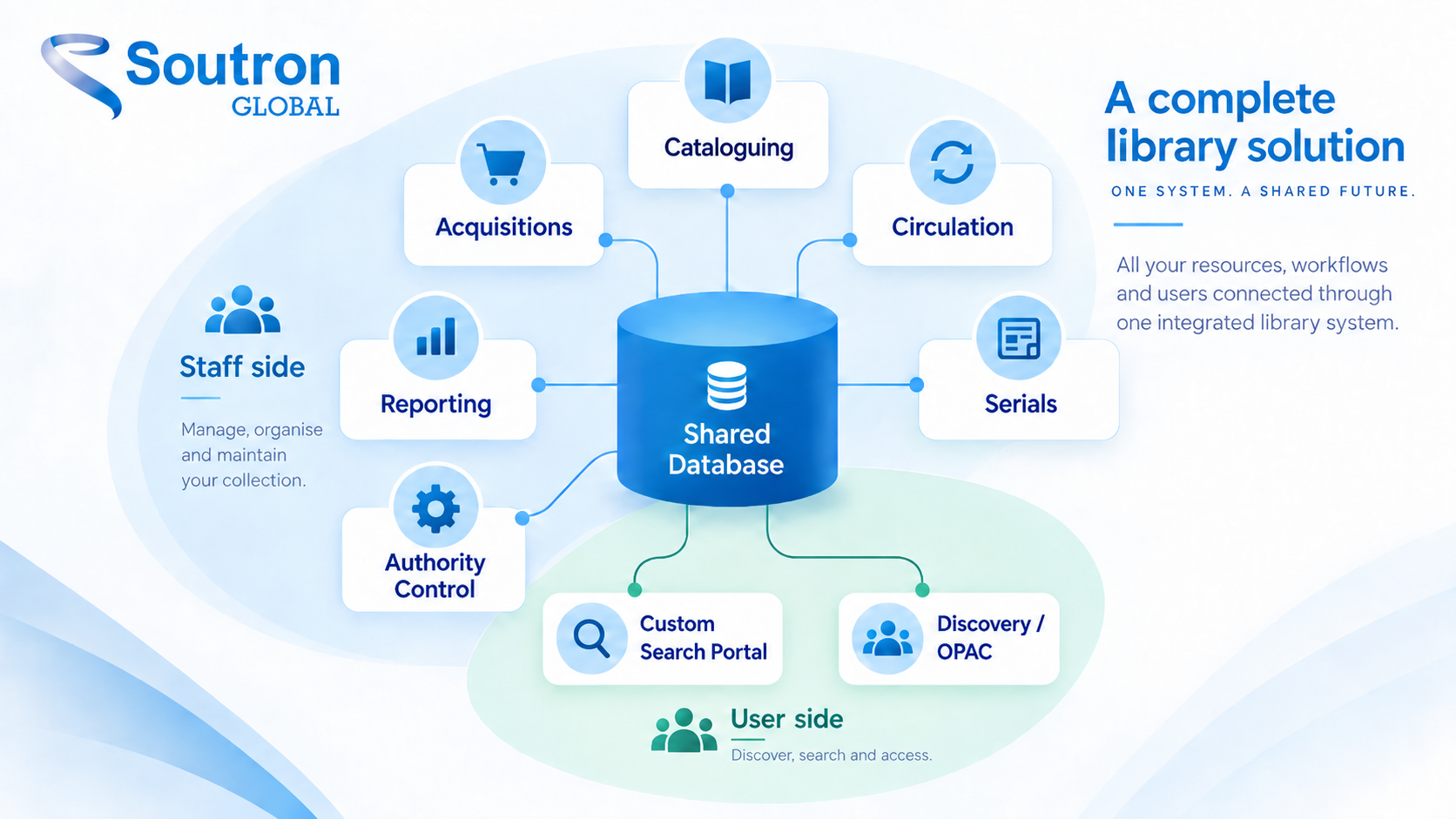
Integrated Library System (ILS): Robust bibliographic and holdings metadata supports circulation, acquisitions, serials and discovery in special, corporate and legal libraries where enterprise data meets user needs.
Archive and Records Management: Descriptive, administrative and structural metadata support provenance, series-level and item-level description and long-term retention per archival standards.
Museum and Cultural Asset Management: Object metadata, provenance information, exhibition history and rights metadata ensure collections can be researched and displayed safely. Impact analysis becomes straightforward with proper metadata.
Knowledge Management and Research Hubs: Metadata connects internal reports, expert knowledge, presentations and external resources into a searchable knowledge centre supporting data practitioners across the organisation.
Digital Preservation: Preservation metadata including file formats, checksums, versioning and rights supports long-term access strategies and data profiling requirements.
Resource Sharing and Collaboration: Standardised metadata enables sharing, syndication and exposure of records to partner systems via APIs or union catalogues supporting integration across large enterprises.
By supporting these functions, metadata management software becomes a cornerstone of organisational data strategy. Next, let’s review best practices for implementing effective metadata management.
Best Practices for Metadata Management
Implementing best practices in metadata management is essential for organisations seeking to unlock the full value of their data assets and foster a data-centric culture. By following a strategic approach, institutions can enhance data quality, strengthen data governance and empower both technical and non-technical users to make better, data-driven decisions. Here are key best practices to guide your metadata management journey:
-
Define a Clear Metadata Strategy
Start by establishing a comprehensive metadata strategy that aligns with your organisation’s broader data management goals. This involves setting clear metadata standards, identifying all relevant data sources and determining the scope of your metadata management efforts. A well-defined strategy ensures consistency and provides a roadmap for data governance teams to follow.
-
Leverage a Centralised Metadata Management Platform
Adopt a metadata management platform that automates metadata discovery, ingestion, cataloguing, enrichment and governance. Centralising metadata in a single repository streamlines workflows, reduces manual effort and supports integration with other data management tools, such as data warehouses and analytics platforms. This approach also enables active metadata management, where metadata is continuously updated and leveraged across your data ecosystem.
-
Prioritise Data Quality and Integrity
High-quality metadata is the foundation of trusted data and effective data intelligence. Implement robust data profiling, validation and cleansing processes to ensure metadata is accurate, complete and up-to-date. Regular quality assessments help maintain data integrity and support compliance with regulatory requirements, especially in regulated industries.
-
Ensure Secure Data Access and Protection
Protect sensitive data by implementing role-based access controls and robust security measures. Encrypt metadata both at rest and in transit and establish clear authentication and authorisation protocols. These steps are vital for maintaining data security and supporting compliance with data policies and governance frameworks.
-
Foster a Data-Centric Culture and Improve Data Literacy
Encourage a culture where data is viewed as a strategic asset. Provide ongoing training and resources to help business users, data practitioners and non-technical users understand the value of metadata management. Improving data literacy across teams ensures broader user adoption and maximises the impact of your metadata management tools.
-
Embrace Active Metadata Management and Automation
Utilise active metadata management to automate the capture, enrichment and activation of metadata. Incorporate machine learning and AI to enhance metadata quality, reduce manual effort and deliver actionable insights to business users. Automation not only accelerates workflows but also supports continuous improvement in metadata discovery and data lineage tracking.
-
Integrate Metadata with Analytics Tools
Connect your metadata management platform with analytics tools and business intelligence systems. This integration provides users with a unified view of data and metadata, enabling more effective data discovery, impact analysis and self-service analytics. Seamless integration also supports data-driven decision making across the organisation.
-
Monitor, Analyse and Visualise Metadata
Continuously monitor and analyse metadata to uncover trends, patterns and opportunities for improvement. Use data visualisation tools to make metadata insights accessible and actionable, helping teams understand data provenance, data flows and the business context of information assets.
-
Maintain Regulatory Compliance and Governance
Ensure your metadata management practices align with industry regulations and internal data policies. Implement business glossaries, data governance frameworks and audit trails to support compliance and provide transparency for data governance teams.
-
Measure Success and Drive Continuous Improvement
Establish clear metrics to evaluate the effectiveness of your metadata management initiatives. Track data quality, data access, user adoption and business outcomes to identify areas for enhancement and demonstrate the business value of your metadata management efforts.
By adopting these best practices organisations can transform their approach to metadata management improving data quality, enhancing data governance and unlocking new opportunities for data intelligence and business value. Modern metadata management tools not only streamline workflows and reduce manual effort but also empower users at every level to access trusted data, understand data provenance and make informed decisions. As the data landscape evolves, continuous monitoring, integration and education will ensure your metadata management strategy remains effective and future-ready.
With these best practices in mind, let’s move on to how to evaluate and select the right metadata management software for your institution.
Choosing Metadata Management Software for Your Institution
Choosing the right metadata management tool can significantly impact your organisation’s data management capabilities. When selecting a metadata management tool, it is crucial to align the tool with your organisation’s specific data management goals. Data security and compliance are top priorities for any organisation when selecting a metadata management tool. Scalability and performance are key considerations when choosing a metadata management tool. A robust metadata management tool should offer features such as data lineage tracking, access control and efficient data search capabilities. This section is designed to help organisations understand how to evaluate and select metadata management software, ensuring the chosen solution aligns with organisational goals, security, compliance and scalability needs.
Functional Fit: Evaluate support for physical and digital collections, archival description, authority control, thesaurus management and integration with existing repositories.
AI Capabilities: Consider whether software provides practical AI features like metadata extraction with human-in-the-loop controls rather than just busswords. Look for tools that improve data literacy and user adoption.
Scalability and Performance: Ensure the system handles growing PDF and digital object backlogs without degrading search performance for end users working in regulated industries.
Usability and Adoption: Prioritise intuitive web interfaces with a user friendly interface for cataloguers and researchers. Customisable forms and training resources ensure broad adoption and reduce the need for technical expertise.
Security and Compliance: Requirements include role-based access control, audit logs and secure handling of content for data governance teams managing sensitive data.
Total Cost of Ownership: Look beyond license price to configuration effort, maintenance and vendor support particularly for cloud-based SaaS deployments serving data teams long-term.
By carefully considering these factors organisations can select a metadata management solution that not only meets current needs but also supports future growth and compliance requirements.
From Creation to Curation: A New Role for Information Professionals
One of the most compelling advantages of Soutron’s AI‑assisted cataloguing is the shift in how cataloguers contribute value.
| Before | Now |
| Staff manually created or copied metadata for each new asset. | AI generates the foundation; cataloguers provide expert‑level curation. |
This new model leads to:
- Faster throughput
- Fewer bottlenecks
- Richer and more consistent metadata
- Ability to prioritise high‑value tasks
The result is more complete and discoverable collections without sacrificing quality.
Conclusion: The Future of Metadata Management Software Is AI‑Enhanced, Expert‑Guided and Scalable
As organisations face increasing demand for sophisticated metadata management, Soutron’s AI‑assisted extraction capabilities represent a decisive leap forward. By blending intelligent automation with human expertise, Soutron empowers archivists, librarians and knowledge managers to deliver richer, faster and more reliable access to essential information.
Ready to explore AI-assisted cataloguing ? Schedule a conversation with Soutron Global to review your current workflows and see metadata management and data intelligence capabilities in action.

FAQ
Does Soutron’s AI-assisted metadata extraction replace cataloguers and archivists?
The AI feature assists and enables rather than replaces professional expertise. AI drafts records while cataloguers review, correct and approve them through the human-in-the-loop workflow. Institutions retain full control over cataloguing standards and decisions. This shift allows professionals to focus on higher-value tasks such as policy development, complex description and user services rather than routine data management.
Which AI models can we use with Soutron’s metadata extraction?
Soutron supports secure connections to OpenAI services, Microsoft Azure OpenAI and organisation-specific large language models where available. This flexibility allows institutions to align with existing security, privacy and AI governance policies. Soutron consultants help clients determine which option fits their technical environment, supporting both ai agents and traditional business processes.
Is the AI metadata extraction limited to PDFs?
The spring 2026 release focuses on PDF documents the dominant format for reports, research outputs and grey literature in libraries and archives. Soutron actively evaluates support for additional formats like Word documents, images and AV transcripts based on client demand. Contact Soutron to discuss specific content types relevant to your data products and collections.
How does Soutron handle custom taxonomies and local cataloguing rules?
Soutron allows institutions to configure custom fields, vocabularies and classification schemes reflecting local practice. AI-extracted concepts map into these custom structures, ensuring new records align with existing metadata strategies. Soutron’s professional services team assists with taxonomy design, migration from legacy systems and ensuring your organisation can improve data literacy through consistent metadata.
How can we get started with Soutron metadata management and AI-assisted cataloguing ?
Begin by reviewing your current cataloguing workflows, backlogs and discovery challenges. Book a discovery call or live demo with Soutron Global to see metadata management, thesaurus control and AI extraction capabilities in context. Soutron provides guidance on implementation timelines, training plans and phased rollouts tailored to your institution’s size and complexity delivering full value from your investment.