Introduction
This article is intended for library professionals and decision-makers evaluating library management solutions. It explores how the criteria for selecting open-source versus commercial library software have evolved in response to new technological and organizational demands and outlines how commercial software has become the lower-risk, more sustainable choice for most modern libraries.
Open-source library software and commercial (proprietary) library software are the two main categories of library automation software. As the technology landscape and organizational expectations have shifted, so too have the evaluation criteria for these systems. While open-source library software was once championed as the ultimate budget-saving alternative, the modern technology landscape has fundamentally inverted the cost-benefit equation.

While open-source library software once appeared cost-effective, today’s operational, security, and governance demands increasingly make commercial solutions the more reliable and accountable choice for most organizations. Understanding this shift is crucial for libraries seeking to make informed, future-proof decisions about their technology investments.
At a time when budgets are constrained and digital library requirements are relatively modest, open-source platforms appear to provide a practical and cost-effective solution. However, expectations around integration, reporting, remote access, security, and compliance have become more demanding today, making free software a less attractive starting point for many organisations. Today’s evaluation criteria have evolved in ways that increasingly favor commercial platforms for most organizations.

The Changing Integrated Library System Technology Landscape
Modern Library Technology Requirements
Between 2020 and 2026, the environment surrounding library technology changed significantly. Modern library management systems are expected to handle hybrid collections, integrate with enterprise tools, and offer advanced reporting, cloud hosting, digital asset management, single sign-on, and strong compliance support. They must also provide flexible tools for authentication services, enterprise APIs, secure cloud hosting and more. Meanwhile, cybersecurity threats are becoming more frequent and more sophisticated.
Evolving Development Models
The nature of software development has also evolved. Open-source projects that once benefited from highly active development communities now encounter fragmented development efforts, inconsistent maintenance, and varying levels of security oversight. Industry audits bear this out: the annual Open Source Security and Risk Analysis report found that 91% of codebases contained open source components with no development activity in the past two years. Freedom to modify the software can be valuable, but in practice often leads to heavily customized deployments that are difficult to upgrade, test, and secure over time.
Today’s open-source adoption is less about license savings alone and more about how well organisations can support integrated library system requirements through actively maintained tools that fit broader library management needs.
Adding to that complexity, organisations face increasing scrutiny regarding software governance, vendor accountability, and data protection.
Security Considerations
The rise of AI-assisted software development has introduced additional concerns. In community-driven open-source projects, contributors might use AI tools (like Copilot or ChatGPT) to submit code patches that look functional but contain hidden vulnerabilities. While AI tools can accelerate coding, Veracode’s GenAI Code Security Report found that AI-generated code introduced security vulnerabilities in 45% of test cases when not subject to rigorous review and testing. Open-source communities rarely have the budget for rigorous, automated static application security testing (SAST) for every community contribution. Commercial vendors do.
Many of the widely used open-source library software products have documented failure modes, ranging from specific security vulnerabilities and system downtime to complex data mapping issues during migrations. Examples of recent security patches issued to fix these flaws include:
- Cross-Site Scripting (XSS)
- Remote Code Execution (RCE) flaw allowing authenticated administrators to execute arbitrary commands on the backend server
- SQL injection bugs
While the open-source ILS platforms themselves primarily deal with software vulnerabilities, third-party open-source hosting providers associated with these systems have been impacted by major data breaches affecting sensitive user information, systematic maintenance burdens, cloud infrastructure updates, and codebase bugs.

Commercial library software SaaS platforms like Soutron offer risk-transference through contractual Service Level Agreements (SLAs), shifting the burden of uptime, compliance, and patch management away from internal IT.
Who is Accountable if it Fails?
In modern procurement environments, accountability has become the defining factor. When systems fail, organisations must answer a critical question: Who is responsible?
Accountability is particularly difficult to manage in decentralized open-source environments, where no single accountable party is responsible for systematic review and remediation of vulnerabilities. The OWASP Foundation’s Top 10 Risks for Open Source Software formally classifies unmaintained software as a leading operational risk, noting that patches for bugs may not be provided in a timely fashion, or at all. As a result, software security and accountability have become more important evaluation criteria than ever before.

System failures, data breaches, or unsupported components are no longer technical inconveniences—they can result in reputational damage, compliance violations, and operational disruption. These evolving requirements have also changed how organizations evaluate the costs and benefits of different library management solutions.
The Shift from License Cost to Total Cost of Ownership in Library Management Software
Beyond License Fees
Historically, software evaluations often focused heavily on license fees. Open-source solutions appeared less expensive because the software itself could be obtained at little or no cost.
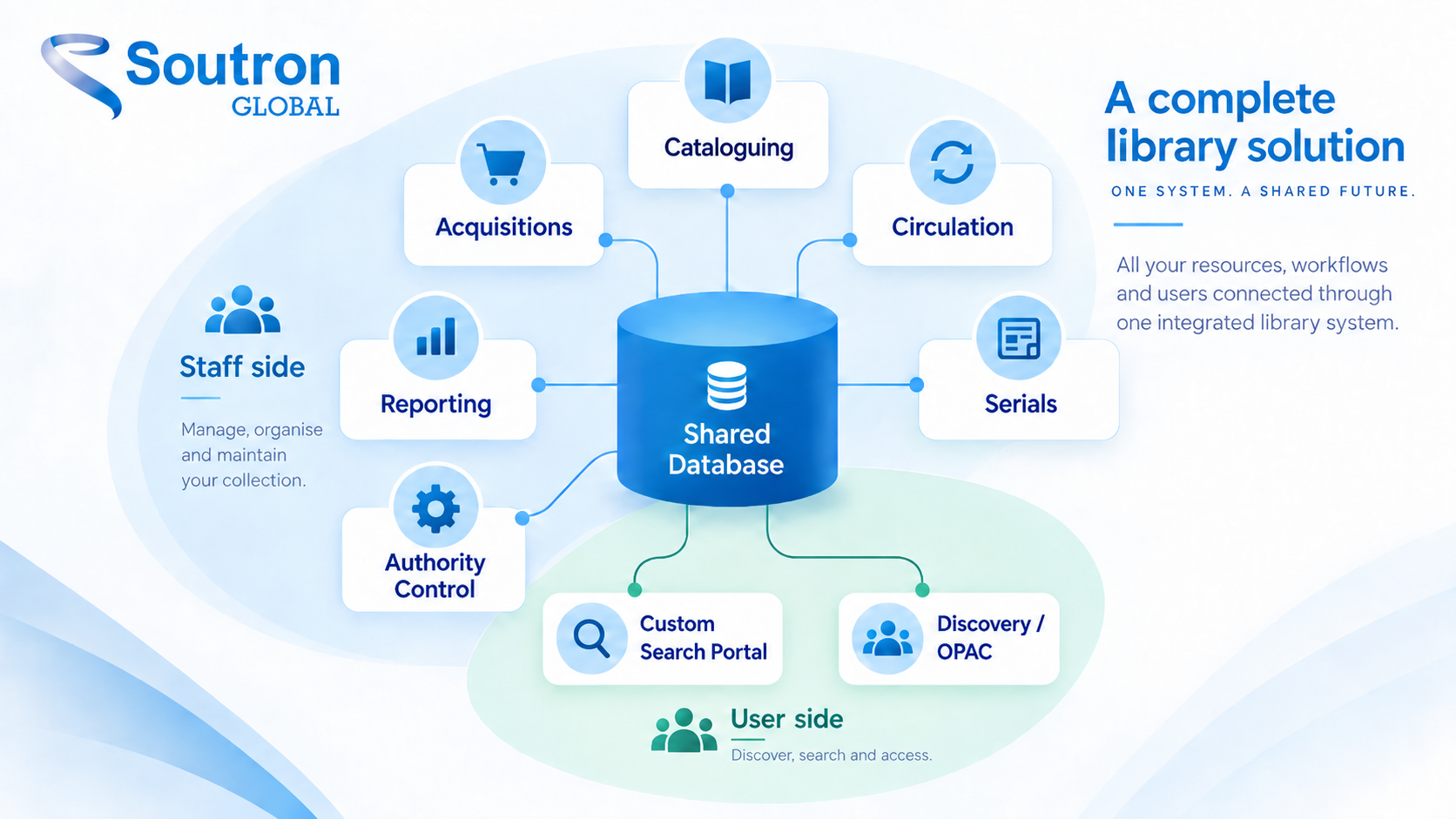
In practice, however, organizations increasingly recognize that software costs extend well beyond the initial license price. Modern library management software must support cataloging, circulation, search, acquisitions, and document management for users, members, and other customers, whether for a corporate library, a legal library, or larger public library systems, as well as nonprofit charitable organizations. Open-source platforms may look low cost at first, but frequently require investments in installation, implementation, hosting, maintenance, upgrades, integrations, security management, and specialist technical expertise. Independent analyses of the unseen costs and latent risks of open source software reach the same conclusion: organizations must budget for total cost of ownership and allocate dedicated resources for maintenance, support, and the possibility of migrating away from unmaintained components. Web-based access on any device is now expected for working with a collection of books, media, and other materials.
While the core software may be free, advanced reporting, authentication services, enterprise integrations, digital asset management capabilities, secure hosting, and ongoing support are often paid additions. Over time, these costs can become fragmented, unpredictable, and difficult to justify during procurement and budgeting reviews. Here is a list of the Top 5 hidden cost areas that surprise procurement officers:
| Cost Factor | The Open Source Reality | The Commercial SaaS Reality |
| Initial Licensing | $0 upfront license fees | Predictable subscription model |
| Hosting & Infrastructure | Variable (Cloud costs or bare metal) | Bundled into single annual fee |
| Security & Patching | Internal IT responsibility / High risk | Covered by vendor SLA agreements |
| Upgrades & Customization | Free, but custom code breaks upgrades | Managed seamlessly by vendor |
| Technical Support | Reliant on community forums/third parties | Dedicated 24/7 technical help-desk |
Governance, Accountability, and Risk Management
Expanding Stakeholder Involvement
Perhaps the most significant change is not technological but organisational. What has changed most between 2020 and 2026 is who participates in software selection decisions. Library system evaluations now routinely involve IT departments, procurement teams, security specialists, compliance officers, senior management, and library staff across larger organizations and consortiums.
Risk Management and Documentation
Technology decisions must be documented, defensible, and aligned with organisational risk-management frameworks. Decision-makers are increasingly expected to demonstrate not only that a system meets functional requirements, but also that risks to users, including privacy obligations, have been properly assessed and mitigated. Costs also need review across data migration, installation, hosting, support, customization, and training rather than being treated as predictable one-time savings.
Due to fragmented code bases that have become common, documentation quality can vary across open-source projects. In many open-source ILS projects, documentation is maintained by a small subset of contributors, which can lead to gaps during upgrades or staff transitions—especially in heavily customized deployments. This can make troubleshooting, ongoing maintenance, and support feedback harder to maintain. Heavily customized systems may also face compatibility issues during upgrades, increasing long-term ownership costs.
Accountability in Software Selection
As a result, the central question has shifted:
The key question is no longer, “Can we make this work?” but rather, “Who is accountable if this fails?”
This shift has fundamentally altered how organisations evaluate open-source and commercial software. With governance and risk management now at the forefront, organizations are increasingly considering the advantages of commercial solutions.
Why Commercial Solutions Are Gaining Favour
Many organisations now view commercial software not simply as a technology purchase, but as a risk-management strategy. Commercial vendors provide clear accountability for system performance, security updates, ongoing product development, service levels, and technical support. Responsibility for maintaining and improving the platform rests with a dedicated development organisation rather than a distributed community of contributors, which matters when teams need an actively maintained, web-based platform for online access, reliable search, and support across multiple branches.
Advantages of Commercial Platforms
| Strategic Business Value | Description |
|---|---|
| Predictable and Transparent Costs | Commercial systems provide predictable, transparent pricing, giving users clear pricing models for budgeting ongoing expenses. |
| Security Practices | Designed for sensitive collections and institutional data, with regular updates. |
| Ongoing Product Development | Informed by librarians and information professionals, ensuring relevance and innovation. |
| Structured Support and SLAs | Guaranteed technical support and response times. |
| Integrated Compliance and Security | Built-in tools and processes for meeting regulatory requirements. |
| Reduced Internal Technical Dependence | Less need for in-house technical expertise for maintenance and troubleshooting. |
By supporting hybrid collections, enterprise integrations, and modern digital workflows, commercial systems help organisations manage operational and reputational risk more consistently over time. As organizations weigh these advantages, the debate between open-source and commercial solutions becomes less about cost and more about long-term value and accountability.
Understanding Open-Source Library Software
Open-source library software is software that allows libraries to study, modify, and redistribute code, is typically available without license fees, and is developed through community collaboration. It provides libraries with a cost-effective alternative to proprietary systems and enables them to modify the software to meet changing user needs. Open-source software also provides control over data without vendor lock-in.
Key Features and Core Benefits
- Cost-Effective Alternative: Open-source library software offers libraries a cost-effective alternative to proprietary systems.
- Freedom to Modify: Allows libraries to study, modify, and redistribute code.
- Community Collaboration: Promotes community collaboration in software development.
- No License Fees: Libraries typically do not pay for open-source software licenses and avoid licensing fees.
- Customizability: Libraries can modify open-source software to meet changing user needs.
- Data Control: Provides control over data without vendor lock-in.
Open-source library software allows libraries to study, modify, and redistribute code, offers a cost-effective alternative to proprietary systems, and promotes community collaboration in software development. Libraries typically do not pay for open-source software licenses and avoid licensing fees. However, open-source systems require technical expertise for maintenance and implementation, and documentation quality can vary. Customized systems typically face compatibility issues during upgrades.
Common Open Source Library Systems
| System | Type | Best For | Support Model |
|---|---|---|---|
| Koha | Open Source | Public Libraries | Third Party |
| Evergreen | Open Source | Consortia | Third Party |
| FOLIO | Open Source | Academic Libraries | Mixed |
All three place responsibility for hosting, security, and upgrades on the library or its contracted third-party support provider.
Ask These Questions Before You Choose a Library System
The strongest procurement decisions are built on risk questions rather than feature lists. Before shortlisting any open source or commercial library platform, make sure you can answer questions like these:
- Who is contractually accountable for security patching and vulnerability remediation?
- Is there a published Service Level Agreement covering uptime and support response times?
- What are the fully loaded year-two and year-three costs beyond licensing?
- Who owns compliance documentation when IT, security, or auditors come asking?
- How is the product roadmap funded, and what happens if a key contributor or support firm walks away?
If a provider cannot give a clear, contractual answer to these questions, the true cost of the system is not yet known. Here’s another tip for selecting a vendor: If you have to go chasing after the vendor for answers to your questions pre-sale, give some thought as to what that vendor’s support will be like post sale. Will you have to keep chasing after them?

Conclusion
The debate between open-source and commercial library software is no longer primarily about license costs. Instead, organisations are increasingly evaluating software through the lenses of governance, accountability, security, and long-term sustainability.
| Area | Open Source | Commercial |
|---|---|---|
| Accountability | Distributed | Vendor-owned |
| Security Ownership | Internal | Vendor-managed |
| Support | Community / Third Party | SLA-backed |
| Cost Predictability | Variable | Predictable |
| Compliance Readiness | Organization Dependent | Typically Built-In |
| Upgrades | Can Be Complex | Managed Process |
| Technical Resources Needed | Higher | Lower |
| Risk Management | Internal Responsibility | Shared Through Vendor Contract |
While open-source solutions offer flexibility, they place the burden of security, maintenance, and long-term sustainability on the organization. For most institutions operating under modern compliance and risk expectations, this model is increasingly difficult to justify compared to commercially supported platforms. For many institutions operating in increasingly regulated and security-conscious environments, commercial platforms provide a more predictable and accountable framework for managing technology risk.
The modern software selection process is therefore less about finding the lowest-cost option and more about identifying the solution that delivers sustainable value, operational resilience, and clear accountability over the long term.
For organizations that must meet modern expectations for security, compliance, and service reliability, commercial library systems are no longer just an alternative—they are increasingly the operationally responsible choice.
Frequently Asked Questions (FAQs)
What is open source library software?
Open source library software is a library management system whose source code is freely available to study, modify, and redistribute, typically without license fees. Well-known examples include Koha, Evergreen, and FOLIO. While the software itself is free to download, libraries must fund their own hosting, implementation, maintenance, security patching, and support, either internally or through a paid third-party firm.
Is open source library software really free?
No. The license is free, but the total cost of ownership includes hosting, implementation, integrations, security management, upgrades, and ongoing support. Most libraries pay a third-party support vendor for these services, and those fees are often comparable to a commercial SaaS subscription, without the contractual accountability of a vendor SLA.
What should libraries evaluate before selecting an open source library system?
Libraries should assess, and schools or a small school library should also consider ease of use and collection size:
- Security controls
- Compliance requirements
- Technical expertise
- Hosting needs
- Upgrade processes
- Vendor support options
- Integration requirements
- Long-term sustainability
What are the disadvantages of open source library software?
The main risks are the absence of a single accountable vendor, security patching that depends on volunteer contributors, variable documentation quality, upgrade complications in customized deployments, and unpredictable long-term costs. This support fragmentation has led to documented vulnerabilities, including SQL injection, cross-site scripting, and remote code execution flaws.
How does commercial library software differ from open source library software?
Commercial library software provides predictable vendor-managed support, service-level agreements, structured upgrades, security management, compliance support, accountable ownership for product development and maintenance, and more structured support for serials management. Open source systems do give libraries code-level control but also shift responsibility for security, maintenance, and sustainability onto the organization, while commercial platforms may also deliver a stronger online library experience for discovery and remote access.
Which libraries benefit most from commercial library software?
Organizations with strict compliance requirements, limited IT resources, multiple locations, complex integrations, or mission-critical information services often benefit from commercially supported platforms.
Is open source library software secure?
Security varies by project. Open source ILS platforms have published patches for serious vulnerabilities, and community projects rarely have the resources for systematic security testing of every contribution. Commercial vendors are contractually accountable for patch management, uptime, and compliance, which is why security-conscious organizations increasingly favor them. Explore project security histories and join community discussions before deciding whether any open-source option meets their risk tolerance.