Records management is the practice of organising, securing, retaining, and disposing of an organisation’s records throughout their lifecycle, from creation or receipt to eventual archiving or secure destruction. Done well, it keeps information accurate, findable, and defensible when an auditor or regulator comes asking. This guide explains what counts as a record, the stages every record moves through, who is responsible, and why the work matters for organisations of any size.
What counts as a record?
A record is any information an organisation creates or receives in the course of business that has value as evidence of an activity, transaction, or decision, whatever its format. It might be a signed contract, an invoice, an email confirming an agreement, a board report, a case file, or a row in a database. What separates a record from an ordinary file is evidential value: it documents something the organisation did or decided, and it may need to be retrieved, trusted, or defended later.
Not everything you store qualifies, and not everything you keep is worth keeping. Much of what accumulates on shared drives is ROT: redundant, obsolete, or trivial content that no longer serves a purpose. Duplicate copies, superseded drafts, and expired working files add cost and noise, and a core part of the discipline is identifying that material and clearing it out.
What are the stages of the records management lifecycle?
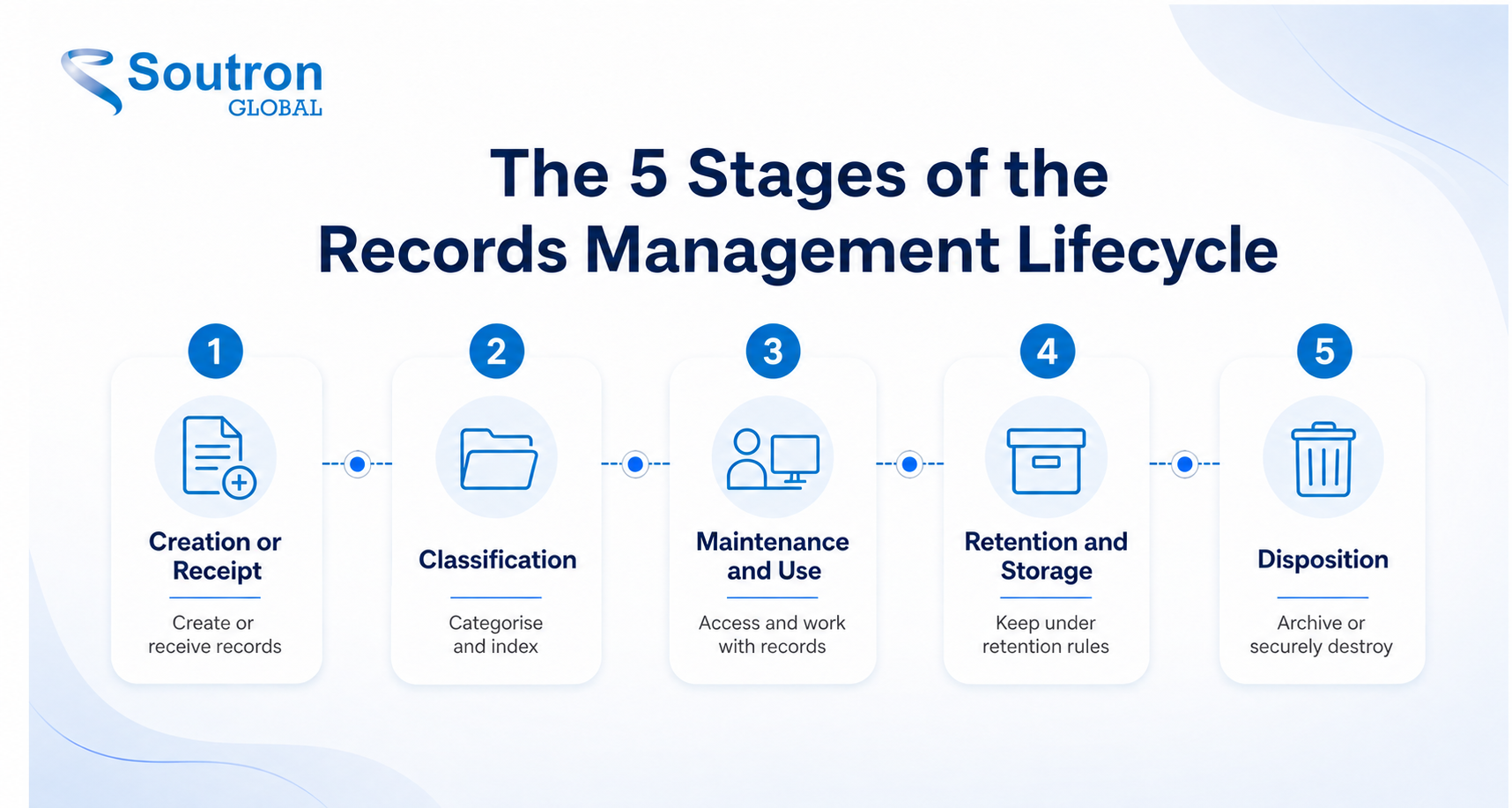
Every record follows a predictable path from the point it is created to the point it is retired, and the records lifecycle is the discipline of controlling that path on purpose rather than by accident. It is commonly described in five stages, each carrying its own decisions about how a record is classified, stored, and eventually disposed of.
|
Stage |
What happens | Example |
|
1. Creation or receipt |
A record is made or received | An invoice is issued, a contract is signed, or an email arrives |
| 2. Classification | The record is categorised and indexed so it can be found |
Tagged by type, department, or retention rule |
|
3. Maintenance and use |
The record is accessed, updated, and shared during daily work | Staff retrieve a policy or update a case file |
| 4. Retention and storage | The record is kept for a set period under a retention schedule |
A financial record held for the legally required number of years |
| 5. Disposition | The record is securely destroyed or archived for long-term keeping |
Confidential files are securely destroyed; historic records are archived |
Disposition is where a record either reaches secure destruction or moves into long-term keeping. Records with lasting legal, historical, or cultural value are not destroyed but archived, and material meant to remain usable for decades needs a deliberate digital preservation approach rather than ordinary storage.
Why does records management matter?
Poor records management rarely announces itself. It surfaces later: in the contract no one can find during due diligence, the personal data kept long past the point it should have been deleted, or the hours staff lose each week hunting for the current version of a file. Done properly, it closes those gaps. The benefits are concrete.
- Compliance and audit readiness: Meet your legal and regulatory retention obligations, and produce the right record, in the right version, when a regulator or auditor asks.
- Lower risk: Records that are lost, wrongly exposed, or kept past their disposal date are the ones that become breaches, penalties, and legal exposure.
- Faster retrieval: Staff find what they need instead of searching across drives, inboxes, and shared folders for a document that may already be out of date.
- Lower storage cost: Every duplicate and expired file still has to be stored, backed up, and secured. Clearing it out stops you paying to keep information that no longer earns its place.
- Trustworthy information: Clean, well-governed records are the foundation for sound decisions, and for any AI tool that draws on your organisation’s own content.
The retrieval cost alone is easy to underestimate. A 2012 McKinsey Global Institute analysis estimated that interaction workers spend close to 20% of the working week, almost a full day, looking for internal information or tracking down colleagues who can help.
Which laws and standards govern records?
For most organisations, this is not optional. Depending on your sector, jurisdiction, and the records you hold, one or more of the rules below already shapes how certain records must be protected, retained, and disposed of, and larger organisations often answer to several at once.
It helps to separate the two kinds of rules. A standard such as ISO 15489 sets out how to run a records programme well and is adopted voluntarily. A legal requirement such as UK GDPR, HMRC’s record-keeping rules, or the Freedom of Information Act 2000 tells you what you are legally required to do, and carries real consequences when you fall short.
| Standard / regulation | What it covers | Who it applies to |
|---|---|---|
| ISO 15489 | International standard for records management best practice | Any organisation, worldwide |
| UK GDPR & Data Protection Act 2018 | Lawful handling of personal data, including keeping it no longer than necessary | Organisations handling UK residents’ personal data |
| HMRC record-keeping rules | Retention of VAT and company financial records, generally for at least six years | UK businesses |
| Freedom of Information Act 2000 | Access to, and sound management of, public authority records | UK public sector bodies |
Records carrying long or permanent retention requirements are where records management meets the archive, held for years as part of a managed business archives programme and disposed of only when the retention rule allows.
Who is responsible for records management?
Responsibility usually sits with a dedicated records manager or a records and information management (RIM) team, whose job is to set retention schedules, classify records, and decide when material is disposed of or archived. In smaller organisations, that role often falls to whoever owns compliance, operations, or IT, without a formal title attached.
But it is not something one person can enforce alone. Every employee who creates or receives a record shares responsibility for handling it correctly, putting it where colleagues can find it rather than in a personal folder or a duplicate no one else can see. Leadership sets the frame above both: approving the records policy, funding the systems, and signing off the retention rules that everyone else works to.
Records management vs related terms
These four disciplines overlap enough in everyday use that they often get treated as interchangeable, yet each answers a different question. Records management governs how long a specific record is kept and when it is disposed of. Document management handles how working files are stored, versioned, and shared day to day. Information governance is the wider policy layer that sets the rules for all of an organisation’s information, records included, and is usually put into practice through an information management solution that stores the content and applies the organisation’s access and retention rules. Archiving is the final stage, providing long-term or permanent custody for records whose continuing legal, historical, or cultural value justifies keeping them.
|
Discipline |
Focus | How it differs |
|
Records management |
Managing records through their lifecycle to disposition | Governed by retention rules; focused specifically on records |
| Document management | Storing, versioning, and sharing working documents day to day |
Broader set of files; not always tied to retention |
|
Information governance |
The overall strategy and policy for all information |
The umbrella; records management sits inside it |
| Archiving | Long-term preservation of records with lasting value |
The end stage for records worth keeping permanently |
What does effective records management require?
Whatever software you use, a records management programme depends on a handful of controls working together. When one of them is missing, records tend to drift back into the shared-drive sprawl the discipline is meant to prevent.
- A clear classification structure, so records are grouped consistently and can be found by type, department, or retention rule.
- Defined retention schedules, setting how long each type of record is kept before it is destroyed or archived.
- Access controls, matched to the sensitivity of each record so the right people, and only the right people, can reach it.
- Reliable metadata and indexing, so authorised users can retrieve a record quickly rather than searching for it.
- Controlled disposition, for secure destruction or transfer to an archive once a record reaches the end of its schedule.
- Documented responsibilities, so it is clear who owns each part of the lifecycle.
- An audit trail, where accountability or regulatory requirements make one necessary.
How Soutron supports records management
Everything above applies whether or not you ever use dedicated software. Where a system earns its place is in enforcing the lifecycle consistently, rather than leaving retention and disposal to memory and scattered shared drives.
Records management software from Soutron manages records from creation through to secure disposition. Each record can be held permanently or managed against a retention and disposal schedule, so what happens to it follows a defined rule rather than an ad hoc decision. Access is governed by role-based security permissions, and records stay organised and findable through a poly-hierarchical thesaurus, metadata, and branded search portals across your own collections. For teams that already work in other systems, Soutron can be deployed in the cloud or installed on-premise where required, with its UK hosting platform holding ISO 27001 certification. It integrates with enterprise applications such as SharePoint and iManage, and includes data migration support to bring your existing records across.
| Soutron helps organisations govern records from creation to secure disposition, backed by 50+ years supporting information teams. If you are mapping out how to bring structure to your records, the first step is to learn more. Learn More → |
Frequently asked questions
What is records management?
Records management is how an organisation controls its records from the moment they are created or received until they are archived or securely destroyed. It covers classifying records, storing them, applying retention rules, and disposing of them properly, so information stays accurate, findable, and defensible throughout its life.
How long should you keep business records?
It depends on the record type and the rules that apply to it, so there is no single answer. Retention periods are set by law, regulation, and business need, and recorded in a retention schedule. In the UK, for example, HMRC expects VAT and company financial records to be kept for at least six years, while personal data should be held only as long as necessary under UK GDPR.
What is a records retention schedule?
A retention schedule is a documented plan that sets how long each type of record is kept and what happens at the end of that period, whether it is securely destroyed or moved to an archive. It turns retention from an individual judgment call into a consistent rule, and it is one of the core tools of any records management programme.
What does ROT stand for?
ROT stands for redundant, obsolete, and trivial content: information that no longer has any real value. Redundant means duplicate copies, obsolete means superseded or expired material, and trivial means content that never had lasting importance. Identifying ROT and clearing it out reduces storage cost and makes the records that matter easier to find.
What is the difference between records management and document management?
Records management follows records through a governed lifecycle to disposition, controlled by retention rules that dictate how long each record is kept. Document management focuses on storing, versioning, and sharing working documents day to day, and is not always tied to retention. Many organisations run both, since a document can later become a record.
Can an email be an official record?
Yes, an email becomes a record when it provides evidence of a business activity, transaction, or decision, for example confirming an agreement, approving a request, or issuing an instruction. Most day-to-day email is not a record and can be deleted, but messages that document something the organisation did should be captured and retained like any other record.
The bottom line
Records management is less about software and more about a decision every organisation makes: whether records are actively governed across their lifecycle, or simply left to accumulate until someone needs one and cannot find it. The organisations that do it well are rarely the ones with the most rules. They are the ones that stay consistent: records classified when they are created, kept only as long as they should be, and disposed of on schedule. Getting there starts with a clear picture of what you hold and what the rules require, and the sections above are a working map for that first step.